
A thermostat only knows the temperature where it hangs, which is usually a hallway. If the upstairs bedroom runs four degrees warmer or the home office is always cold, the hallway reading doesn’t help. A thermostat with remote sensor support fixes that: you put a small wireless sensor in the room you care about, and the thermostat heats or cools based on that room instead of (or as well as) its own reading.
Not every smart thermostat can do this, and the ones that can handle sensors in quite different ways. Some count only temperature, some also detect which rooms are occupied, and one uses Echo speakers you may already own. Below are the six options worth buying in the US right now, with what each sensor actually does. Prices are regular list prices, not temporary deals.
Quick Recommendations
- ecobee Smart Thermostat Premium — Best overall. A SmartSensor in the box, occupancy-based comfort, and Apple Home, Alexa and Google Home support.
- Honeywell Home X8S with Room Sensor — Best for large homes. Up to 20 sensors with a 200 ft range, plus Matter.
- Google Nest Learning Thermostat (4th Gen) — Best for Google Home. A Temperature Sensor in the box and sensor schedules by time of day.
- Aqara Thermostat Hub W200 — Best for Apple Home. Matter, a built-in Thread and Zigbee hub, and room sensors from about $36.
- ecobee Smart Thermostat Essential — Best value. The same SmartSensor support as the Premium for about $120 less.
- Amazon Smart Thermostat — Best for Alexa homes. Uses compatible Echo speakers as room sensors.
Remote Sensor Thermostats at a Glance
| Product | Ecosystem | Key Feature | Approx. Price | Best For |
|---|---|---|---|---|
| ecobee Smart Thermostat Premium | Apple Home, Alexa, Google Home, SmartThings | 1 SmartSensor included, up to 32 | ~$260 | Most homes |
| Honeywell Home X8S with Room Sensor | Matter (Apple Home, Alexa, Google Home, SmartThings) | 1 sensor included, up to 20, 200 ft range | ~$260 | Large and multi-story homes |
| Google Nest Learning Thermostat (4th Gen) | Google Home, Matter | 1 sensor included, up to 6 | ~$280 | Google Home users |
| Aqara Thermostat Hub W200 | Matter (Apple Home, Alexa, Google Home, SmartThings) | Built-in hub, sensors sold separately | ~$160 | Apple Home users |
| ecobee Smart Thermostat Essential | Apple Home, Alexa, Google Home, SmartThings | SmartSensor support, sensors sold separately | ~$140 | ecobee on a budget |
| Amazon Smart Thermostat | Alexa | Up to 10 Echo devices as sensors | ~$80 | Alexa homes with Echo speakers |
Compatibility Matrix
Values come from each manufacturer’s own documentation.
| Product | HomeKit | Alexa | Google Home | Matter | Thread | Hub Required | Wiring/Power |
|---|---|---|---|---|---|---|---|
| ecobee Smart Thermostat Premium | Yes | Yes (built in) | Yes | No | No | No | C wire or included adapter |
| Honeywell Home X8S with Room Sensor | Via Matter | Yes | Yes | Yes | Not stated | No | C wire (free adapter voucher) |
| Google Nest Learning Thermostat (4th Gen) | Via Matter | Yes | Yes | Yes (Wi-Fi) | No | No | Most 24V systems, Power Connector if needed |
| Aqara Thermostat Hub W200 | Via Matter | Yes | Yes | Yes | Yes (border router) | No | C wire or $30 adapter |
| ecobee Smart Thermostat Essential | Yes | Yes | Yes | No | No | No | C wire or adapter (sold separately) |
| Amazon Smart Thermostat | No | Yes | No | No | No | No | C wire required |
The Amazon Smart Thermostat is the one to watch here: it works only with Alexa. ecobee covers every major platform but doesn’t support Matter, so if Matter matters to you, look at the Honeywell, Nest or Aqara (or our guide to Matter thermostats).
The 6 Best Smart Thermostats with Remote Sensors
ecobee Smart Thermostat Premium — Best Overall

The ecobee Premium is the most complete smart thermostat with room sensors you can buy. A SmartSensor comes in the box, and ecobee’s sensors track occupancy as well as temperature, so the thermostat can focus on the rooms people are actually in.
Best for: most homes with one or two problem rooms, especially if you use more than one smart home platform.
What stands out in real use
Occupancy. Each SmartSensor reports both temperature and whether the room is in use, and Follow Me adjusts the temperature for the rooms that are occupied right now. Smart Home & Away uses the same sensors to tell when everyone has left, so the thermostat saves energy without a geofence on your phone. The thermostat itself adds radar occupancy sensing, an air quality monitor and a built-in speaker with Alexa (or Siri, through a HomePod). You can add more sensors later, up to 32 per account.
Key specs
- 1 SmartSensor included (temperature + occupancy)
- Sensor range up to 60 ft, battery up to 5 years
- Up to 32 sensors per account
- Radar occupancy, air quality monitor, 4 in touchscreen
- Alexa built in, Siri through a HomePod
Pros
- Sensor and C-wire adapter (Power Extender Kit) both in the box
- Occupancy sensing in every SmartSensor, not just temperature
- Works with Apple Home, Alexa, Google Home and SmartThings
Cons
- No Matter support
- Extra sensors add up (about $100 for a 2-pack)
- The most expensive ecobee
Installation and compatibility notes
The Premium includes ecobee’s Power Extender Kit, so most homes without a C wire can still install it (see our C-wire adapter guide for when it applies). It connects to Apple Home directly, not through Matter.
Price: ~$260
Honeywell Home X8S with Room Sensor — Best for Large Homes
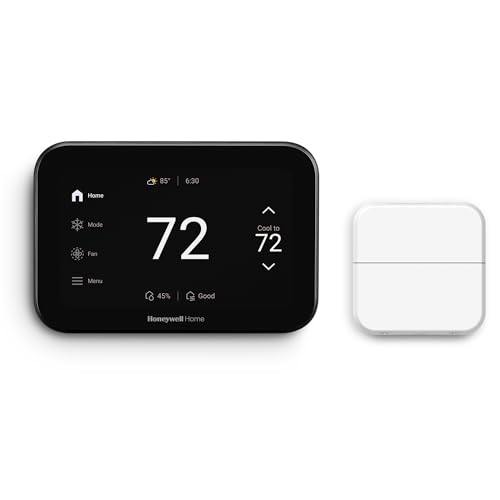
The Honeywell X8S takes more sensors, farther away, than anything else here: up to 20, with a range of up to 200 ft. It’s also Matter certified, which ecobee isn’t. Honeywell’s newer X7S works with the same sensors for less, and our guide to the best Honeywell thermostats compares the two.
Best for: large or multi-story homes, and anyone who wants a sensor-heavy setup that also works through Matter.
What stands out in real use
The sensor options. Each X Series room sensor measures temperature, humidity and motion. In Active Rooms mode, any room where the sensor detects motion becomes a priority, and the thermostat works from the average of those rooms. You can also pick specific rooms and schedule which ones count, for example the bedrooms at night. The 5 in touchscreen can also show live video from Ring and First Alert doorbells and lets you talk to visitors.
Key specs
- 1 room sensor included (temperature, humidity, motion)
- Up to 20 sensors, range up to 200 ft
- Active Rooms and selected-room priority modes
- Matter certified
- 5 in touchscreen with doorbell video
Pros
- The highest sensor count and longest range here
- Sensors add humidity readings, not just temperature
- Matter, so it works with Apple Home, Alexa, Google Home and SmartThings
- Works with some older Honeywell T9 sensors
Cons
- Needs a C wire (an adapter voucher is in the box)
- Matter only passes the temperature, setpoint and mode, so room priority stays in the Honeywell app
- Some older Honeywell sensor models don’t work with it
Installation and compatibility notes
The X8S needs a C wire, but Honeywell includes a voucher for a free C-wire adapter in the box. Honeywell’s RCHTSENSOR (the T9’s sensor) works with it, but the C7189R2002-2 doesn’t, so check the model number before you reuse an older sensor.
Price: ~$260
Google Nest Learning Thermostat (4th Gen) — Best for Google Home

The 4th gen Nest Learning Thermostat comes with a Nest Temperature Sensor (2nd gen) in the box and supports up to six. It’s the simplest way to get room sensing if your home already runs on Google Home.
Best for: Google Home users who want a thermostat that learns their routine and mostly runs itself.
What stands out in real use
Sensor schedules. You can tell the thermostat to use the living room sensor in the evening and the bedroom sensor overnight, and the 4th gen can also average several sensors at once. The sensors are simple: they measure temperature only, with no occupancy or humidity, and connect over Bluetooth Low Energy at about 50 ft. The thermostat learns your schedule and adjusts automatically, and it supports Matter, so it also works in Apple Home and Alexa.
Key specs
- 1 Nest Temperature Sensor (2nd gen) included
- Up to 6 sensors per thermostat, 18 per home
- Sensor range about 50 ft, CR2 battery up to 2 years
- Matter over Wi-Fi
- Learns your schedule automatically
Pros
- Sensor included, and easy to set up in the Google Home app
- Sensor schedules by time of day, plus averaging on the 4th gen
- Matter support for Apple Home and Alexa
Cons
- Sensors measure temperature only (no occupancy)
- Over Matter, the sensors stay in Google Home
- The most expensive option here
Installation and compatibility notes
The Nest Temperature Sensor works only with the Nest Learning Thermostat (3rd and 4th gen) and the Nest Thermostat E. It doesn’t work with the cheaper Nest Thermostat (2020), so don’t buy that model if room sensing is the goal (Google’s sensor page has the full list). If you use Apple Home, our Nest and HomeKit guide explains what Matter does and doesn’t pass through. Amazon sells the 4th gen through third-party sellers rather than Amazon.com directly, so check that the listing says new and includes the sensor.
Price: ~$280
Aqara Thermostat Hub W200 — Best for Apple Home

The Aqara W200 is a Matter thermostat that also works as a smart home hub, and Aqara says it’s the first thermostat with Apple’s Adaptive Temperature and Clean Energy Guidance features. It doesn’t include a room sensor, but Aqara’s sensors are cheap.
Best for: Apple Home users, and anyone who wants room sensors without paying ecobee or Honeywell prices.
What stands out in real use
The W200 works with Aqara’s Climate Sensor W100 (about $36), which shows the room’s temperature and humidity and has buttons you can use to adjust the thermostat from your desk or bed. It also works with the FP300 presence sensor. At launch it could follow one sensor at a time; a July 2026 firmware update added averaging across several sensors. Because the W200 is also a Zigbee hub, Thread border router and Matter controller, it can run the rest of your Aqara devices too.
Key specs
- No sensor included (Climate Sensor W100 sold separately)
- Matter 1.4, Thread border router, Zigbee 3.0 hub
- Built-in mmWave presence sensor
- 4 in touchscreen, dual-band Wi-Fi
- Apple Adaptive Temperature and Clean Energy Guidance support
Pros
- About $100 less than the ecobee Premium or Honeywell X8S
- Works with Apple Home, Alexa, Google Home, SmartThings and Home Assistant
- Doubles as a hub for Aqara and other Matter devices
- W100 sensors are inexpensive and have physical buttons
Cons
- No sensor in the box
- Needs a C wire, or Aqara’s $30 adapter
- Multi-sensor averaging is new, so expect updates
Installation and compatibility notes
Aqara says the W200 works with about 85% of HVAC systems, including furnaces, central air, heat pumps and boilers, but not line voltage or millivolt systems. You’ll need a C wire, or Aqara’s C-Wire Adapter (sold separately). For more Apple-first options, see our best HomeKit thermostats.
Price: ~$160
ecobee Smart Thermostat Essential — Best Value

The ecobee Essential works with the same SmartSensors as the Premium for about $120 less. You buy the sensors separately, so it suits anyone who wants to choose how many rooms to cover.
Best for: ecobee fans on a budget, or homes that need two sensors from the start.
What stands out in real use
Once you add SmartSensors, you get the same Follow Me and Smart Home & Away features as the Premium, with temperature and occupancy from every sensor. A SmartSensor 2-pack is about $100, so the Essential plus two sensors costs about the same as the Premium with one. What you give up is the thermostat’s own occupancy sensor, the air quality monitor and the built-in speaker.
Key specs
- No sensor included (SmartSensor 2-pack about $100)
- Up to 32 sensors per account
- 2.4 GHz Wi-Fi 6
- Touchscreen
- Works with Apple Home, Alexa, Google Home, SmartThings
Pros
- The cheapest way into ecobee’s sensor system
- Same SmartSensors, with occupancy, as the Premium
- Direct Apple Home support
Cons
- No sensor or C-wire adapter in the box
- No occupancy sensing in the thermostat itself
- No Matter, and 2.4 GHz Wi-Fi only
Installation and compatibility notes
The Essential needs a C wire. If you don’t have one, ecobee’s Power Extender Kit is sold separately for about $25.
Price: ~$140
Amazon Smart Thermostat — Best for Alexa Homes

The Amazon Smart Thermostat doesn’t have dedicated room sensors. Instead, it uses the temperature sensor inside compatible Echo speakers, which makes it the cheapest way to get room-by-room readings if you already own them.
Best for: Alexa homes with Echo Dots in the bedrooms.
What stands out in real use
In the Alexa app, you choose up to 10 compatible devices as temperature sensors: the Echo (4th gen), Echo Dot (5th gen), Echo Dot with Clock (5th gen) and the Amazon Smart Air Quality Monitor. When you select more than one, the thermostat uses the average of all of them. Everything lives in the Alexa app, with no separate thermostat app or skill to link.
Key specs
- No sensor included; uses compatible Echo devices
- Up to 10 sensors, averaged
- Alexa only
- Made with Honeywell Home technology
- C wire required
Pros
- The lowest price here, at about $80
- Echo speakers you already own become sensors
- Simple setup in the Alexa app
Cons
- Alexa only: no Apple Home, Google Home or Matter
- Several sensors are always averaged, with no room priority
- Schedules are limited to four changes a day
Installation and compatibility notes
The Amazon Smart Thermostat needs a C wire. Only the Echo models listed above count as sensors, so check your Echo’s generation before you rely on it.
Price: ~$80
How to Choose a Smart Thermostat with Room Sensors
Temperature only, or occupancy too
This is the biggest difference between systems. ecobee SmartSensors and Honeywell’s X Series sensors also detect motion, so the thermostat can focus on the rooms in use and ignore empty ones. Nest and Echo-based sensors only report temperature, so you decide which rooms count, either by schedule (Nest) or by picking devices (Amazon). Aqara gets occupancy from a separate presence sensor.
How the thermostat uses more than one sensor
Most systems either average the sensors you select or let you prioritize specific rooms. Averaging is good for evening out a whole floor. Priority is better when one room matters most at a certain time, like a nursery at night. ecobee, Honeywell and Nest let you change which sensors count by schedule or occupancy; the Amazon Smart Thermostat always averages.
Range and where to put sensors
Sensor range varies a lot: about 50 ft for Nest, 60 ft for ecobee and up to 200 ft for Honeywell. Walls, floors and appliances shorten it. Place each sensor on an inside wall, away from vents, windows, lamps and direct sun.
Check what’s in the box
Only the ecobee Premium, Honeywell X8S with Room Sensor and Nest Learning (4th gen) include a sensor. For the others, add the cost of sensors before you compare prices. And check the wiring: most of these need a C wire or an adapter.
Final Recommendations
For most homes, the ecobee Smart Thermostat Premium is the best thermostat with remote sensor support: its SmartSensors track occupancy as well as temperature, one comes in the box, and it works with every major platform except Matter. For a big house that needs many sensors, or a Matter home, the Honeywell X8S takes up to 20 and reaches farther.
Google Home users should go for the Nest Learning Thermostat (4th gen), and Apple Home users will get the most from the Aqara W200. If you’re on a budget, the ecobee Essential uses the same sensors, and the Amazon Smart Thermostat turns your Echo speakers into room sensors for about $80.
Does the Nest Thermostat work with remote sensors?
Only some models do. The Nest Temperature Sensor works with the Nest Learning Thermostat (3rd and 4th gen) and the Nest Thermostat E. It doesn’t work with the cheaper Nest Thermostat (2020).
How many remote sensors can a smart thermostat use?
It depends on the brand. ecobee allows up to 32 SmartSensors per account, the Honeywell X8S up to 20 sensors, the Nest Learning Thermostat up to 6 per thermostat, and the Amazon Smart Thermostat up to 10 compatible Echo devices.
Do ecobee SmartSensors detect occupancy?
Yes. Each ecobee SmartSensor reports temperature and occupancy, which powers features like Follow Me (adjusting for the rooms in use) and Smart Home & Away (saving energy when everyone has left).
Can I use an Echo as a thermostat sensor?
With the Amazon Smart Thermostat, yes. It can use up to 10 Echo (4th gen), Echo Dot (5th gen), Echo Dot with Clock (5th gen) or Amazon Smart Air Quality Monitor devices as temperature sensors, and averages their readings.
Which thermostat with room sensors works with Apple Home?
The ecobee Premium and Essential connect to Apple Home directly. The Honeywell X8S, Nest Learning Thermostat (4th gen) and Aqara W200 join through Matter. The Amazon Smart Thermostat doesn’t work with Apple Home.

Written by Evan Mercer
Founder & Lead Researcher, Smart Home Matrix
Evan digs through spec sheets, firmware changelogs, and thousands of owner reviews so you don’t have to. Every guide starts with a compatibility check and ends with picks he would install in his own home. Read more about Evan and this site, or see exactly how we choose products.