
Eufy and Reolink are the two brands people usually compare when they want security cameras without a monthly fee. Both save video at your home and detect people for free, so the eufy vs Reolink choice comes down to something else. Eufy makes simple battery cameras and doorbells that store clips inside the device. Reolink offers more 4K cameras, 24/7 recording on its plug-in models, and more ways to store and use your footage.
This guide compares how each brand records, what it costs, how it works with Alexa, Google and Apple Home, and which cameras and doorbells are worth buying from each one.
Eufy vs Reolink: The Short Answer
Quick answer: choose eufy if you want battery cameras and doorbells that are easy to set up, store clips on the device and recognize familiar faces, or if you use Apple Home. Choose Reolink if you want 4K video at a lower price, 24/7 recording, dual-band Wi-Fi, a longer warranty, or a system you can run completely locally with Home Assistant. Neither brand needs a subscription.
If you already know which way you’re leaning, these are the six products worth looking at:
- eufy SoloCam S340 — Best eufy camera, with two lenses and a built-in solar panel.
- Reolink Argus PT Ultra — Best Reolink battery camera, with 4K video and a solar panel in the box.
- eufy Video Doorbell E340 — Best eufy doorbell, with a second camera that watches for packages.
- Reolink Battery Video Doorbell (2nd Gen) — Best Reolink doorbell, with a head-to-toe view and 24/7 recording when wired.
- eufyCam S3 Pro 2-Cam Kit — Best eufy system, with 4K cameras, a HomeBase 3 and Apple Home support.
- Reolink E1 Outdoor Pro — Best Reolink camera for 24/7 recording, with 4K video and 3x optical zoom.
What Eufy Does Best
Eufy’s main advantage is how simple local storage is. Many of its doorbells and battery cameras save clips to built-in memory (8 GB on the SoloCam S340 and Video Doorbell E340), so you don’t need to buy a memory card or a hub to get started. If you want more space, the HomeBase S380 (also called HomeBase 3) stores clips from several cameras on 16 GB that expands up to 16 TB with a hard drive. If you choose eufy, our guide to the best eufy cameras helps you choose a model.
Person detection runs on the device, so it’s free. The HomeBase S380 adds face recognition that tells family members apart from strangers, and many eufy doorbells also detect packages.
Eufy is also the only one of the two with Apple Home support, although only on some models. The eufyCam S3 Pro works with Apple Home and HomeKit Secure Video, and our does eufy work with HomeKit guide lists every model and how each one connects.
However, there are some downsides. Many eufy battery cameras and doorbells use 2.4 GHz Wi-Fi only, and most of the lineup records in 2K or 3K rather than 4K. Eufy’s warranty on cameras is also shorter, at 12 months.
What Reolink Does Best
Reolink gives you more video quality and more recording options for the money. The Argus PT Ultra records in 4K and costs less than eufy’s 3K SoloCam S340, and the Reolink cameras in this guide use dual-band Wi-Fi, so they can connect on 5 GHz when your 2.4 GHz band is crowded.
Reolink’s plug-in and wired cameras can record 24/7 to a microSD card (up to 512 GB on current models), not just motion clips. You can also save video to a Reolink Home Hub, a Reolink NVR, or your own network storage. Person, vehicle and animal detection is free on the device, and Reolink’s doorbells add package detection.
Reolink is also the better choice if you want to keep everything at home. According to Home Assistant’s Reolink integration page, Reolink cameras can run fully locally, keep working in the Reolink app when their internet access is blocked, and don’t need a cloud account for local storage. Reolink cameras come with a two-year warranty, twice as long as eufy’s.
The downsides: Reolink doesn’t work with Apple Home, and its app has many more settings, which you may not need if you only want a doorbell and a camera or two.
Reolink vs Eufy Side by Side
Here’s how the two brands compare on the points that matter most:
| Factor | eufy | Reolink |
|---|---|---|
| Typical prices | About $150 to $200 for a camera or doorbell, $550 for a 4K two-camera kit | About $150 to $170 for a 4K camera or 2K doorbell |
| Recording without a plan | Yes, onboard storage, microSD or HomeBase | Yes, microSD, Home Hub, NVR or network storage |
| 24/7 recording | Some wired models and NVR systems | Plug-in, PoE and wired models |
| Free AI detection | Person, plus faces, pets and vehicles with HomeBase S380 | Person, vehicle and animal, plus packages on doorbells |
| Wi-Fi | Mostly 2.4 GHz | Dual-band 2.4 and 5 GHz on newer models |
| Cloud backup | Optional, from $3.99 a month | Optional, on some models only |
| Alexa and Google Assistant | Yes | Yes, on most models |
| Apple Home | Some models | No |
| Warranty | 12 months on cameras | 2 years |
Storage and recording
This is the biggest difference in any Reolink vs eufy comparison, even though both brands record for free. Battery cameras from either brand only record clips when they detect motion, because recording all day would drain the battery in days. A eufy battery camera saves those clips to its own memory or a HomeBase, and a Reolink battery camera saves them to a microSD card or a Reolink Home Hub.
The difference is in wired cameras. A Reolink plug-in camera like the E1 Outdoor Pro can record 24/7 to a microSD card, so you can scroll back through everything that happened, not just the moments that triggered an alert. Eufy’s 24/7 recording is limited to some wired models and its NVR systems, and most of its lineup is built around battery cameras.
If you’re not sure which type you need, our guide to security cameras without a subscription explains the difference between clip recording and continuous recording in more detail.

Cloud plans
Neither brand needs a plan, but both offer cloud backup in case someone steals a camera or the hub.
Eufy’s cloud plans are simple. Basic costs $3.99 a month for one device, $7.99 for two or $11.99 for three, and Plus costs $13.99 a month for every camera on your account. Both keep 30 days of history, and our guide to eufy subscriptions explains what they add.
Reolink Cloud is more limited. It’s only available on some models, mostly Reolink’s 4G cameras and doorbells, and cameras connected to a Reolink Home Hub can’t use it. Prices depend on the model and the number of cameras, so check the Reolink app for your camera.
Smart home compatibility
Both brands work with Alexa and Google Assistant, mainly to show live video on an Echo Show or a Nest Hub. Eufy’s cameras don’t stream inside the Google Home app, though: you ask Google Assistant to show the camera on a smart display instead.
Eufy has an advantage for Apple users, because a few models (including the eufyCam S3 Pro) work with Apple Home and HomeKit Secure Video. Reolink doesn’t work with Apple Home, and neither brand makes a Matter camera yet. If you already own Reolink cameras, our guide to using Reolink with HomeKit covers the bridge options.
Reolink is the better choice for Home Assistant. It’s an official Home Assistant partner, its cameras connect to Home Assistant over your home network, and its plug-in and PoE cameras also support RTSP and ONVIF, so you can record them with other software.
Wired and PoE systems
If you’re planning a wired system with several cameras, Reolink’s PoE kits cost less. A four-camera Reolink kit with an 8-channel NVR and a 2 TB drive costs about $540 in 5MP or $750 in 4K. Eufy now sells PoE NVR systems too, but they start at about $1,100 and only work with eufy’s own PoE cameras, while Reolink’s NVRs also list support for ONVIF cameras. If you’re not sure what an NVR does, our NVR vs DVR comparison explains it, and our Reolink vs Lorex comparison shows how Reolink’s kits compare with Lorex’s.
Our guide to the best PoE security camera systems compares these kits in detail.
Privacy and security
With either brand, your clips stay on a device in your home unless you turn on cloud backup, which is one of the main reasons people choose them.
Eufy had a serious privacy problem in 2022, when a researcher found that its cameras uploaded thumbnails to the cloud even with cloud storage turned off, and that live streams could be opened without logging in by anyone with the right link. Eufy fixed the problems, and in February 2025 its US distributors settled with the New York Attorney General for $450,000 and agreed to stronger encryption and regular security testing.
Reolink is the easier brand to run without any cloud connection at all. Like any connected camera, though, it has had security flaws that were fixed with firmware updates. With either brand, keep the firmware up to date and turn on two-factor authentication in the app.
Eufy vs Reolink Doorbell
For a battery doorbell, the eufy vs Reolink doorbell choice comes down to the view of your porch and how you want to record.
The eufy Video Doorbell E340 has two 2K cameras: one looks straight out, and the second looks down at the ground in front of your door, so you can see packages left at your feet. It saves clips to 8 GB of built-in memory, and it detects people and packages for free. It runs on a removable rechargeable battery or on doorbell wiring (8 to 24V), and it only uses 2.4 GHz Wi-Fi.
The Reolink Battery Video Doorbell (2nd Gen) records a square 2K picture with a 150° by 150° view that shows visitors from head to toe and packages on the ground. Reolink rates the battery at up to 10 months with about five minutes of recording a day, and it records to a microSD card (sold separately) or a Reolink Home Hub. If you connect it to 16 to 24V doorbell wiring and turn on its wired mode, it records 24/7. It uses dual-band Wi-Fi, but Reolink doesn’t recommend it with an existing mechanical chime, so plan on a Reolink Chime Plus (sold separately).
Both doorbells cost about $150. If you’d like other options, see our best doorbell cameras without a subscription guide.
Which Should You Choose?
When people ask whether to buy eufy or Reolink, the answer usually depends on these situations:
- You want the simplest setup with storage built in: eufy. Many models record to their own memory with nothing else to buy.
- You want 4K video for the lowest price: Reolink.
- You want 24/7 recording: Reolink, with a plug-in or PoE camera.
- You use Apple Home: eufy, though not all models work with it.
- You use Home Assistant or want everything to stay local: Reolink.
- You want face recognition for family members: eufy, with a HomeBase S380.
- You want a wired system with several cameras: Reolink, whose PoE kits cost less.
If you’re also considering a brand that records to the cloud, our eufy vs Ring comparison explains how the costs work out.
Which Eufy or Reolink Products to Buy
eufy SoloCam S340 — Best eufy Camera

A battery camera with a built-in solar panel and two lenses: a 3K wide lens and a 2K telephoto lens, with 8x hybrid zoom and motorized pan and tilt. It stores clips on 8 GB of built-in memory and works without a HomeBase, so you don’t need anything else to get started.
Best for: anyone who wants an outdoor camera without a monthly fee that rarely needs charging in a sunny spot.
Price: ~$200
Reolink Argus PT Ultra — Best Reolink Battery Camera

A 4K battery camera with 355° pan, 140° tilt and auto-tracking, sold with a detachable 3W solar panel. It uses dual-band Wi-Fi 6 and records motion clips to a microSD card (up to 512 GB, sold separately) or a Reolink Home Hub. Our guide to the best solar security cameras compares it with other solar models.
Best for: people who want 4K video on a battery camera for less than eufy’s SoloCam.
Price: ~$167
eufy Video Doorbell E340 — Best eufy Doorbell
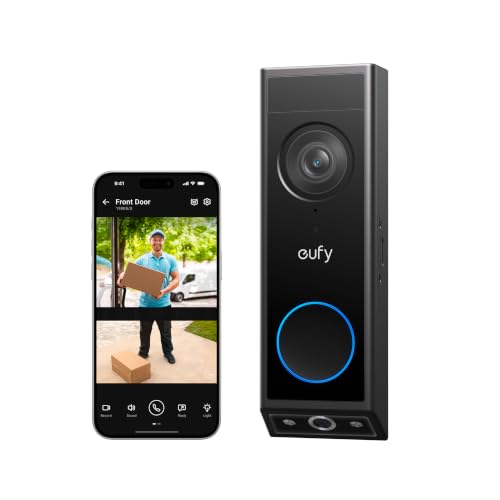
A doorbell with two 2K cameras, one facing forward and one facing down to watch packages. It saves clips to 8 GB of built-in memory and runs on a battery or doorbell wiring.
Best for: people who get a lot of deliveries and don’t want a subscription.
Price: ~$150
Reolink Battery Video Doorbell (2nd Gen) — Best Reolink Doorbell

A 2K doorbell with a square head-to-toe view, free person, vehicle, animal and package detection, and up to 10 months of battery life. On 16 to 24V doorbell wiring, it can record 24/7. You’ll need a microSD card and a Reolink Chime Plus, both sold separately.
Best for: people who want 24/7 recording at the front door, or a doorbell that works with Home Assistant.
Price: ~$150
eufyCam S3 Pro 2-Cam Kit — Best eufy System

Two 4K solar cameras with radar motion detection and a HomeBase 3, which stores up to 16 TB and adds face recognition. It’s one of the few eufy systems that works with Apple Home and HomeKit Secure Video.
Best for: larger homes and Apple users who don’t want a subscription.
Price: ~$550 (for a 2-camera kit with HomeBase 3)
Reolink E1 Outdoor Pro — Best Reolink Camera for 24/7 Recording

A plug-in 4K camera with 3x optical zoom, 355° pan, 50° tilt and auto-tracking. It records 24/7 to a microSD card (up to 512 GB), a Home Hub or an NVR, connects over dual-band Wi-Fi 6 or Ethernet, and works with Google Assistant.
Best for: driveways and yards where you want a full recording of the day, not just motion clips.
Price: ~$150
The Bottom Line
The eufy vs Reolink decision isn’t about subscriptions, because neither brand needs one. Eufy is the easier choice for battery cameras and doorbells with storage built in, and it’s the one to choose if you use Apple Home. Reolink gives you more 4K options for less, 24/7 recording, a longer warranty and a system you can keep completely local. If you choose Reolink, our guide to the best Reolink cameras helps you pick a model.
If you’d like to compare more brands for your yard, see our best outdoor security cameras guide.
Is eufy better than Reolink?
It depends on what you need. Eufy is easier to set up, stores clips inside many of its cameras and doorbells, and works with Apple Home on some models. Reolink offers more 4K cameras for the money, 24/7 recording on plug-in and wired models, a two-year warranty, and fully local use with Home Assistant.
Do eufy and Reolink need a subscription?
No. Both brands record to local storage and detect people without a plan. Eufy’s optional cloud backup starts at $3.99 a month for one device, and Reolink Cloud is optional and only available on some models.
Which records 24/7, eufy or Reolink?
Reolink, on its plug-in and PoE cameras, which can record continuously to a microSD card, a Home Hub or an NVR. Battery cameras from both brands only record clips when they detect motion, and eufy’s 24/7 recording is limited to some wired models and its NVR systems.
Do eufy and Reolink work with Apple HomeKit?
Some eufy cameras do, including the eufyCam S3 Pro with HomeKit Secure Video. Reolink doesn’t work with Apple Home. Both brands work with Alexa and Google Assistant.
Is Reolink or eufy better for privacy?
Both keep video on a device in your home unless you turn on cloud backup. Eufy had encryption problems in 2022 that led to a settlement in 2025, while Reolink cameras can run fully locally without a cloud account. With either brand, keep the firmware up to date.

Written by Evan Mercer
Founder & Lead Researcher, Smart Home Matrix
Evan digs through spec sheets, firmware changelogs, and thousands of owner reviews so you don’t have to. Every guide starts with a compatibility check and ends with picks he would install in his own home. Read more about Evan and this site, or see exactly how we choose products.