
An indoor air quality monitor shows you what you can’t see or smell at home: carbon dioxide building up in a closed bedroom, fine particles from cooking or wildfire smoke, chemicals from new furniture, and in some homes, radon. The best option for most homes is the Airthings View Plus, because it measures all of these in one device and shows the readings on a screen you can check from across the room.
The right monitor depends on two things: what you want to measure, and which smart home platform you use. A simple CO2 monitor is enough to tell you when a room needs fresh air, while a full air quality monitor for home use also tracks particles and chemicals. Every option below works with an app, and four of them work with Alexa, Google Home or Apple Home.
Quick Recommendations
- Airthings View Plus — Best overall. Measures radon, PM2.5, CO2 and VOCs, with a display and Alexa and Google Assistant support.
- Aranet4 Home — Best CO2 monitor. An accurate CO2 sensor and an e-ink screen that runs for years on two AA batteries.
- Qingping Air Monitor Lite — Best for Apple Home. Shows CO2, PM2.5 and PM10 in the Home app without a bridge.
- SONOFF AirGuard CO2 — Best budget. A CO2 monitor with an alarm and Matter support for about $50.
- Amazon Smart Air Quality Monitor — Best for Alexa. Tracks particles, VOCs and carbon monoxide, and Alexa tells you when the air gets worse.
Top Choices at a Glance
| Product | Ecosystem | Key Feature | Approx. Price | Best For |
|---|---|---|---|---|
| Airthings View Plus | Alexa, Google Assistant | Radon, PM2.5, CO2 and VOCs in one device | ~$330 | Best overall |
| Aranet4 Home | Home Assistant (Bluetooth) | NDIR CO2 sensor, up to 4 years on AA batteries | ~$189 | CO2 accuracy |
| Qingping Air Monitor Lite | Apple Home | CO2, PM2.5 and PM10 in the Home app | ~$76 | Apple Home |
| SONOFF AirGuard CO2 | Apple Home, Alexa, Google Home (Matter) | NDIR CO2 sensor with an alarm | ~$50 | Budget |
| Amazon Smart Air Quality Monitor | Alexa | PM2.5, VOCs and carbon monoxide | ~$70 | Alexa |
Compatibility Matrix
| Product | HomeKit | Alexa | Google Home | Matter | Hub Required | Wiring/Power |
|---|---|---|---|---|---|---|
| Airthings View Plus | No | Yes | Yes | No | No | 6 AA batteries, or USB-C |
| Aranet4 Home | No | No | No | No | No | 2 AA batteries |
| Qingping Air Monitor Lite | Yes | No | No | No | No (home hub for remote access) | USB-C, small built-in battery |
| SONOFF AirGuard CO2 | Yes (via Matter) | Yes (via Matter) | Yes (via Matter) | Yes | Matter hub | USB-C only |
| Amazon Smart Air Quality Monitor | No | Yes | No | No | No | Plug-in power adapter |
The SONOFF AirGuard CO2 is the only option that works with Apple Home, Alexa and Google Home, through Matter. The Aranet4 Home doesn’t work with any of the big three platforms: it sends its readings to your phone over Bluetooth.
The Best Indoor Air Quality Monitors in 2026
Airthings View Plus — Best Overall

The View Plus is the best indoor air quality monitor for most homes because it measures more than any other option here: radon, PM2.5, CO2, VOCs, humidity, temperature and air pressure. It’s expensive, but it replaces two or three single-purpose monitors.
Best for: Homeowners who want one device that covers everything, including radon in a basement or ground-floor room.
What stands out in real use
The e-ink display shows two readings at a time (you choose which ones), and you see the rest in the free Airthings app, with charts that keep your long-term history. The CO2 sensor is an NDIR sensor, the same type used in dedicated CO2 monitors, and the PM2.5 sensor uses a laser to count particles. Radon builds up slowly, so the View Plus shows it as a 24-hour average, and it takes a few days after setup before that number means much. It works with Alexa and Google Assistant, so you can ask for the air quality by voice, and when it’s powered over USB-C it also acts as a hub for Airthings Wave sensors in other rooms.
Key specs
- Radon, PM2.5, CO2 (NDIR), VOCs, temperature, humidity and air pressure
- E-ink display
- 6 AA batteries (up to 2 years, Airthings says) or USB-C power
- 2.4 GHz Wi-Fi
- Alexa, Google Assistant and IFTTT
Pros
- Measures more pollutants than any other option in this guide
- The only option here that tracks radon
- Runs on batteries, so you can place it anywhere
- The app is free and keeps your full history
Cons
- The most expensive option in this guide
- Doesn’t work with Apple Home
- The display only shows two readings at a time
- Battery life is shorter if you set it to measure more often
Installation and compatibility notes
Place it in the room you use most, at breathing height and away from windows, vents and the kitchen stove, so one burst of air doesn’t skew the readings. If you want to use it as a hub for other Airthings sensors, keep it on USB-C power. Airthings says it doesn’t support Apple HomeKit.
Price: ~$330
Aranet4 Home — Best CO2 Monitor
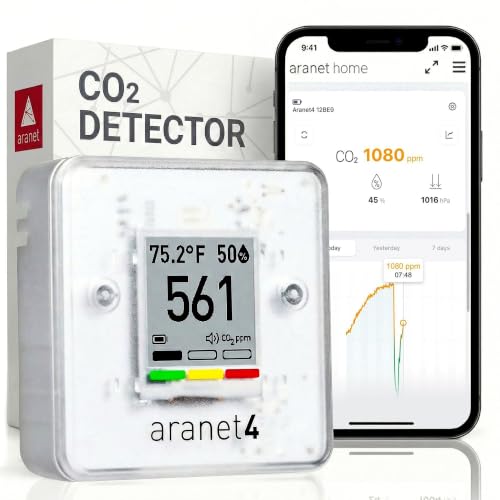
The Aranet4 Home is the best CO2 monitor if you mainly want to know when a room needs fresh air. Its NDIR sensor is rated to ±30 ppm plus 3%, and the e-ink screen lets it run for years on two AA batteries.
Best for: Anyone who wants accurate CO2 readings in a bedroom, home office or kids’ room, without plugging anything in.
What stands out in real use
The screen shows CO2, temperature, humidity and air pressure in large numbers. A buzzer can sound when CO2 reaches the red threshold, which is 1,400 ppm by default, and you can change the thresholds in the app. Because the e-ink screen only uses power when the number changes, Aranet rates the batteries for up to four years. It’s also small and light, so you can move it between rooms to see which one needs more ventilation.
Key specs
- CO2 (NDIR, 0 to 9,999 ppm, ±30 ppm + 3%), temperature, humidity, air pressure
- E-ink display
- 2 AA batteries, up to 4 years
- Bluetooth to the Aranet Home app
- Works with Home Assistant over Bluetooth
Pros
- The most accurate CO2 sensor in this guide
- Years of battery life
- Easy to read, even in bright light
- Portable enough to move from room to room
Cons
- Only measures CO2, not particles or VOCs
- Doesn’t work with Alexa, Google Home or Apple Home
- Bluetooth only, so you can’t check it when you’re away from home
Installation and compatibility notes
The Aranet4 doesn’t use Wi-Fi: your phone reads its history over Bluetooth when you’re nearby. If you use Home Assistant, it can read the Aranet4 directly over Bluetooth once you turn on the Smart Home integration setting in the Aranet Home app.
Price: ~$189
Qingping Air Monitor Lite — Best for Apple Home

The Qingping Air Monitor Lite is the best choice if your home runs on Apple Home. It works with HomeKit directly, so CO2, PM2.5, PM10, temperature and humidity all show up in the Home app without a bridge.
Best for: iPhone users who want air quality readings in the Home app and automations that react to them.
What stands out in real use
You add it to the Home app by scanning the HomeKit code on the bottom, and it connects over 2.4 GHz Wi-Fi. The small screen shows each reading, and a color bar on the front changes as the air gets worse, so you notice it without reading numbers. Because the readings are in Apple Home, you can build automations with them, like turning on an air purifier when PM2.5 goes up. It doesn’t measure VOCs, and the built-in battery only lasts about seven hours, so it’s made to stay plugged into USB-C.
Key specs
- CO2, PM2.5, PM10, temperature, humidity
- Screen with a color status bar
- 2.4 GHz Wi-Fi and Bluetooth
- USB-C power, small built-in battery (about 7 hours)
- Apple Home (native), Mi Home
Pros
- Works with Apple Home without a bridge or Matter
- Measures both CO2 and particles for under $100
- Readings work in Apple Home automations
- Clear color indicator on the front
Cons
- Doesn’t measure VOCs
- Doesn’t work with Alexa or Google Home
- Needs to stay plugged in
Installation and compatibility notes
To see readings and run automations when you’re away from home, Apple Home needs a home hub (an Apple TV or HomePod). Our guide to whether Apple HomeKit requires a hub explains when you need one.
Price: ~$76
SONOFF AirGuard CO2 — Best Budget
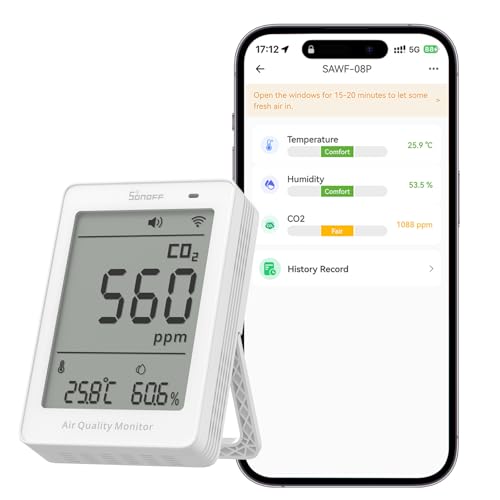
The AirGuard CO2 is the most affordable option in this guide, and it still uses an NDIR CO2 sensor. It also works with Matter, so the same monitor can join Apple Home, Alexa or Google Home.
Best for: Anyone who wants a smart CO2 monitor for a bedroom or office on a budget, whatever smart home platform they use.
What stands out in real use
The screen shows CO2, temperature and humidity, and the readings update every five seconds. You set alert thresholds in SONOFF’s eWeLink app, and the AirGuard warns you with a sound, a colored light and a phone notification when CO2 gets too high. It also keeps a full year of history that you can export. Through Matter, the readings show up in Apple Home, Alexa or Google Home, where you can use them in automations, like turning on a fan when the room gets stuffy.
Key specs
- CO2 (NDIR, 400 to 5,000 ppm, ±50 ppm + 5%), temperature, humidity
- LCD screen, updates every 5 seconds
- Sound, light and app alerts
- 365 days of history with export
- USB-C power (no battery)
- Matter over 2.4 GHz Wi-Fi
Pros
- The lowest price in this guide
- Works with Apple Home, Alexa and Google Home through Matter
- Built-in alarm when CO2 gets too high
- A full year of history
Cons
- Doesn’t measure particles or VOCs
- No battery, so it needs to stay plugged in
- The USB-C port is on the back, which makes wall mounting awkward
Installation and compatibility notes
SONOFF says you need a Matter hub to use it with Apple Home, Alexa or Google Home: an Apple TV or HomePod, a compatible Echo, or a Google Nest speaker or display. To see humidity in the Apple Home app, your iPhone needs iOS 26 or later.
Price: ~$50
Amazon Smart Air Quality Monitor — Best for Alexa

The Amazon Smart Air Quality Monitor is the easiest way to add air quality readings to an Alexa home. It tracks PM2.5, VOCs, carbon monoxide, temperature and humidity, and Alexa can tell you when the air gets worse.
Best for: Alexa households, especially if you have an Echo Show to see the readings.
What stands out in real use
There’s no screen: a colored light on the monitor shows the overall air quality, and you see the details in the Alexa app or on an Echo Show. You can ask Alexa about the air quality, get notifications when it drops, and use the readings in Alexa Routines, like turning on an air purifier or a fan when the air quality drops. If you have the Amazon Smart Thermostat, it can also use this monitor as a temperature sensor. However, it doesn’t measure CO2, so it can’t tell you when a room needs fresh air.
Key specs
- PM2.5, VOCs, carbon monoxide, temperature, humidity
- Color status light (no screen)
- Plug-in power
- Alexa app, Echo Show and Alexa voice
- Temperature sensor for the Amazon Smart Thermostat
Pros
- Affordable for the number of readings
- Works with Alexa Routines
- Easy setup in the Alexa app
- Also helps the Amazon Smart Thermostat
Cons
- Doesn’t measure CO2
- Alexa only: no Apple Home or Google Home
- No screen on the monitor
- Not a replacement for a carbon monoxide alarm
Installation and compatibility notes
The carbon monoxide reading is useful information, but it’s not a certified CO alarm, so keep a real CO alarm on every level of your home. Our guide to the best smart smoke detectors includes combination smoke and CO alarms. For more devices that work with the Amazon Smart Thermostat, see our guide to the best Alexa thermostats.
Price: ~$70
How to Choose an Indoor Air Quality Monitor
Decide what you want to measure. CO2 tells you when a room needs fresh air, and it climbs fast in a closed bedroom or a busy home office. Our guide to good CO2 levels in your home explains which readings are fine and when to ventilate. PM2.5 counts fine particles from cooking, candles and wildfire smoke. VOCs are chemicals from paint, cleaning products and new furniture. Radon is a radioactive gas that can come up through the ground, and the EPA’s radon health risk page recommends fixing your home if the level is 4 pCi/L or more. If radon is your main concern, our guide to the best radon detectors compares dedicated radon monitors and test kits. If you’ve never tested, our guide on how to test for radon explains where to place a kit and which levels are safe. If you only care about ventilation, a CO2 monitor like the Aranet4 or the AirGuard CO2 is enough. For particles too, choose the Qingping or the View Plus.
Look for an NDIR CO2 sensor. NDIR sensors measure carbon dioxide directly. Some monitors only show an “estimated” CO2 value calculated from their VOC sensor, which isn’t the same thing. All the monitors in this guide that show CO2 use NDIR sensors.
Think about where you’ll see the readings. A screen lets you check the air at a glance. The Amazon monitor has no screen, so it works best if you have an Echo Show (our guide to the best smart displays compares the models). The Aranet4 only syncs over Bluetooth, so you can’t check it from work.
Choose battery or plug-in power. The Aranet4 and View Plus run on AA batteries, so you can put them anywhere. The Qingping, AirGuard and Amazon monitors need an outlet nearby.
Match it to your smart home. A smart air quality monitor is most useful when it can trigger other devices, like turning on a purifier or a fan. Choose the Qingping for Apple Home, the Amazon monitor for Alexa, or the AirGuard if you use more than one platform. If particles are the problem, see our guide to the best smart air purifiers, and our explainer on which air purifiers work with Matter covers the ones you can control from any platform. If humidity is, our guide to what humidity should be in your house explains the healthy range, and our humidifier vs dehumidifier comparison shows which device brings it back into that range. If the air is too dry, our guide to the best smart humidifiers compares models that hold the humidity level you set.
Place it carefully. Put the monitor at breathing height in the room you use most, away from windows, vents and the stove, and don’t breathe on it when you read it, because CO2 readings jump when you’re close.
Conclusion
For most homes, the Airthings View Plus is the best indoor air quality monitor: it tracks radon, particles, CO2 and VOCs in one device. If you mainly want to know when to open a window, the Aranet4 Home is the most accurate CO2 monitor, and the SONOFF AirGuard CO2 does the same job for about $50 with Matter support. Apple Home users should choose the Qingping Air Monitor Lite, and Alexa homes get the most from the Amazon Smart Air Quality Monitor.
What does an indoor air quality monitor measure?
Most indoor air quality monitors measure some combination of CO2, fine particles (PM2.5), VOCs, temperature and humidity. Some also measure radon or carbon monoxide. Check which readings a monitor has before you buy, because a CO2 monitor and a particle monitor answer different questions.
What is the best CO2 monitor for home?
The Aranet4 Home is the best CO2 monitor for most homes. It uses an NDIR sensor rated to ±30 ppm plus 3%, shows readings on an e-ink screen, and runs for up to four years on two AA batteries. For a smart CO2 monitor on a budget, the SONOFF AirGuard CO2 also uses an NDIR sensor and works with Matter.
Which air quality monitor works with Apple Home?
The Qingping Air Monitor Lite works with Apple Home directly and shows CO2, PM2.5, PM10, temperature and humidity in the Home app. The SONOFF AirGuard CO2 also works with Apple Home through Matter, with an Apple TV or HomePod as the hub. The Airthings View Plus and Aranet4 Home don’t work with Apple Home.
Does the Amazon Smart Air Quality Monitor measure CO2?
No. The Amazon Smart Air Quality Monitor measures PM2.5, VOCs, carbon monoxide, temperature and humidity, but not carbon dioxide. If you want to know when a room needs fresh air, you need a monitor with a CO2 sensor.
Can an air quality monitor replace a carbon monoxide alarm?
No. Even monitors that show a carbon monoxide reading, like the Amazon Smart Air Quality Monitor, aren’t certified CO alarms. Keep a dedicated carbon monoxide alarm on every level of your home.
Where should I put an indoor air quality monitor?
Put it at breathing height in the room you use most, such as a bedroom or home office. Keep it away from windows, air vents and the kitchen stove, so a single burst of air doesn’t skew the readings.

Written by Evan Mercer
Founder & Lead Researcher, Smart Home Matrix
Evan digs through spec sheets, firmware changelogs, and thousands of owner reviews so you don’t have to. Every guide starts with a compatibility check and ends with picks he would install in his own home. Read more about Evan and this site, or see exactly how we choose products.