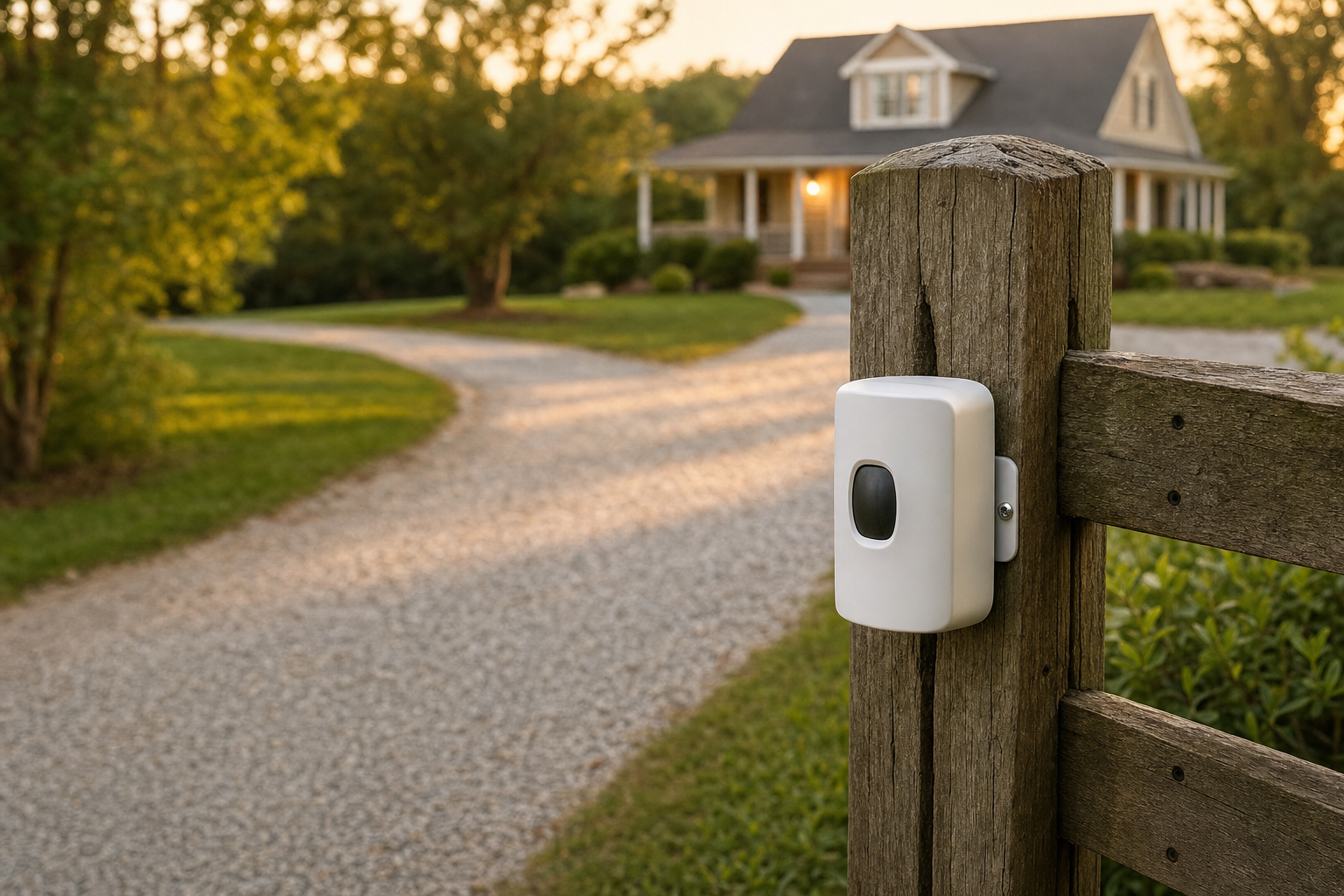
The best driveway alarm for most homes is the HTZSAFE 1/2 Mile Driveway Alarm: for about $44 you get a plug-in receiver and two motion sensors that detect a car or a person up to 50 feet away and chime inside the house. If you want the alert on your phone when you’re away, the YoLink Outdoor Motion Sensor Driveway Kit is the smart option, with spoken announcements and Alexa routines.
A driveway alarm tells you someone is coming before they reach the door. A sensor at the end of the driveway sends a radio signal to a receiver in the house, often from hundreds of feet away, where Wi-Fi doesn’t reach. This guide compares five options by how they detect and how they alert you, from a simple wireless driveway alarm to a buried sensor that only reacts to vehicles. If you also want door sensors, a keypad and monitoring, start with our guide to the best DIY home security systems.
Quick Recommendations
- HTZSAFE Driveway Alarm — Best overall. Two sensors, up to 50 feet of detection and a half-mile range for about $44.
- YoLink Outdoor Motion Sensor Driveway Kit — Best for phone alerts. App, email and text alerts, plus a hub that reads them aloud.
- eMACROS Pro 4 Wi-Fi Solar Driveway Alarm — Best solar option. Solar sensors and app alerts without a separate hub.
- Dakota Alert DCMA-4000 — Best long range. Up to a mile between the sensor and the receiver.
- Mighty Mule FM231 — Best for vehicles only. A buried magnetic sensor that ignores people and animals.
Top Choices at a Glance
| Product | Alerts | Wireless Range | Detection | Approx. Price | Best For |
|---|---|---|---|---|---|
| HTZSAFE Driveway Alarm | Receiver chime | Up to 1/2 mile | Up to 50 ft | ~$44 (for a 2-sensor kit) | Most homes |
| YoLink Outdoor Motion Sensor Driveway Kit | App, email, text, spoken | Up to 2,034 ft | Up to 30 ft | ~$90 (for a 2-sensor kit) | Phone alerts and Alexa |
| eMACROS Pro 4 Wi-Fi Solar Driveway Alarm | App and base alarm | Up to 2,650 ft | Up to 30 ft | ~$100 (for a 2-sensor kit) | Solar power |
| Dakota Alert DCMA-4000 | Receiver chime | Up to 1 mile | Up to 100 ft | ~$70 | Long driveways |
| Mighty Mule FM231 | Receiver chime | Up to 400 ft | 12 ft radius, vehicles only | ~$73 | Fewer false alarms |
Wireless range is the distance from the sensor to the receiver in open ground; trees, hills and walls shorten it.
Compatibility Matrix
| Product | HomeKit | Alexa | Google Home | Matter | Hub Required | Wiring/Power |
|---|---|---|---|---|---|---|
| HTZSAFE Driveway Alarm | No | No | No | No | No (plug-in receiver) | 3 AA per sensor, receiver plugs in |
| YoLink Outdoor Motion Sensor Driveway Kit | Not stated | Yes (routines) | Not stated | Not stated | YoLink hub (included) | 2 AA per sensor, hub plugs in |
| eMACROS Pro 4 Wi-Fi Solar Driveway Alarm | No | Not stated | Not stated | No | No (Wi-Fi base) | Solar + built-in battery |
| Dakota Alert DCMA-4000 | No | No | No | No | No (plug-in receiver) | 9V battery, receiver plugs in |
| Mighty Mule FM231 | No | No | No | No | No (plug-in receiver) | 2 AA, receiver plugs in |
Only the YoLink works with a smart home platform: it can trigger Alexa routines, and it also works with IFTTT and Home Assistant. None of these five works with Apple Home or Matter, and three of them have no app at all, just a receiver that chimes.
The Best Driveway Alarms in 2026
HTZSAFE Driveway Alarm — Best Overall

The HTZSAFE is the simplest way to cover a driveway: plug in the receiver, put batteries in the sensors, and it works, with the longest motion detection of the battery sensors in this guide.
Best for: Homes that want a reliable chime indoors without Wi-Fi, an app or a monthly fee.
What stands out in real use
Each sensor detects moving people and vehicles 35 feet away on low sensitivity and 50 feet on high, and sends the alert up to half a mile to the receiver (HTZSAFE notes that the real range depends on the terrain). The receiver has 35 melodies and four volume levels, so you can give each sensor its own sound and know whether it’s the driveway or the back gate. You can add up to 32 sensors to one receiver, and one sensor can trigger as many receivers as you like, for example one in the kitchen and one in the garage. HTZSAFE says the detection chip is designed to reduce false alarms from leaves, small animals, sunlight and wind, but large animals like deer can still set it off, like any motion sensor.
Key specs
- Up to 1/2 mile (800 m) wireless range
- 35 or 50 feet of motion detection
- 3 AA batteries per sensor (not included)
- Up to 32 sensors per receiver
- 35 melodies, 4 volume levels
- -30 to 150°F, 2-year warranty
Pros
- Longest detection of the battery motion sensors here
- A different sound for each sensor
- Easy to expand with more sensors and receivers
- Lowest price per sensor
Cons
- No phone alerts when you’re away
- The receiver must stay plugged in
- Batteries aren’t included
- Large animals can trigger it
Installation and compatibility notes
The kit comes paired, so setup takes a few minutes: mount the sensors on a wall, fence post or tree facing across the driveway, and plug the receiver into an outlet. It doesn’t connect to Wi-Fi or any smart home platform, which also means it keeps working when your internet goes down.
Price: ~$44 (for a 2-sensor kit)
YoLink Outdoor Motion Sensor Driveway Kit — Best for Phone Alerts
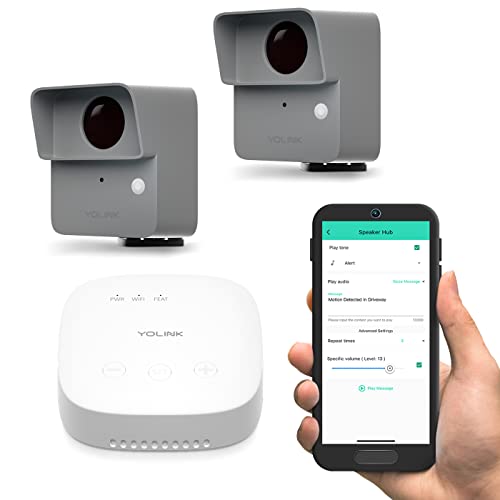
The YoLink kit is the driveway sensor to buy if you want to know about a car in the driveway when you’re not home: it sends app, email and text alerts, and its SpeakerHub announces them in the house.
Best for: Smart homes that want phone alerts, Alexa routines or lights that turn on when a car arrives.
What stands out in real use
The kit includes two outdoor motion sensors and the SpeakerHub, which connects them to the internet over your 2.4 GHz Wi-Fi. The sensors use YoLink’s LoRa radio, not Wi-Fi, which is why they reach up to 2,034 feet in open air. When a sensor is triggered, the SpeakerHub can read the alert out loud and the YoLink app sends a push notification, an email or a text, without a subscription. In the Alexa app, the sensor can start a routine, such as an announcement on your Echo speakers or turning on the porch lights. YoLink sells smart plugs and switches too, so lights connected to them can turn on even without the Alexa step.
Key specs
- LoRa, up to 2,034 feet in open air
- Detects up to 30 feet on a driveway, 80° wide
- Three sensitivity levels
- 2 AA batteries per sensor, over two years according to YoLink
- -4 to 122°F
- SpeakerHub with spoken alerts, 2.4 GHz Wi-Fi
Pros
- Alerts on your phone wherever you are
- Spoken announcements in the house
- Works with Alexa, IFTTT and Home Assistant
- Alerts without a subscription
Cons
- Shortest detection distance of the motion sensors here
- Needs Wi-Fi and a plugged-in hub
- Best mounted under cover
- No support for Apple Home or Google Home listed
Installation and compatibility notes
Set up the SpeakerHub in the YoLink app first, then add each sensor by scanning its QR code. YoLink recommends a mounting height of 5 to 6.5 feet on a wall, and its Amazon listing says to install the sensor in a protected spot away from direct rain, like under an eave or a porch roof. The hub runs on wall power, so if the power goes out, the alerts stop until it comes back. For indoor and other outdoor sensors, our guide to the best smart motion sensors compares more options.
Price: ~$90 (for a 2-sensor kit)
eMACROS Pro 4 Wi-Fi Solar Driveway Alarm — Best Solar Option

The eMACROS Pro 4 is the best choice if you don’t want to change sensor batteries: the sensors charge from the sun, and the base station sends alerts to your phone over Wi-Fi.
Best for: Sunny driveways where you want app alerts without buying a separate hub.
What stands out in real use
The base station is the receiver and the Wi-Fi bridge in one. When a sensor detects motion, the base sounds its alarm (up to 100 dB) and the My Hosmart app sends a push notification to your phone. The base has a built-in battery that keeps it running for up to three days in a power outage, which the other receivers in this guide don’t list. Each sensor has a solar panel and a 2,000 mAh battery, and eMACROS estimates about two years on a full charge even without sun, at 20 triggers a day. Sensors on channels 3 and 4 don’t flash their light when triggered, so a person walking past doesn’t notice them. It’s a newer model, so it has fewer owner reviews than the older eMACROS Pro3.
Key specs
- Up to 2,650 feet in open ground
- Detects up to 30 feet (high) or 20 feet (low)
- 45° wide detection angle
- Solar panel + 2,000 mAh battery, USB-C charging
- IP65 sensors, -4 to 140°F
- Base with up to 3 days of battery backup
Pros
- Solar sensors, without battery changes
- App alerts without a separate hub
- Base keeps working in a power outage
- Two sensors in the box
Cons
- 2.4 GHz Wi-Fi only
- Narrow 45° detection angle
- Doesn’t list Alexa or Google Home support
- Few owner reviews so far
Installation and compatibility notes
Charge the sensors fully before you mount them. The manual recommends 2 to 3 feet off the ground for vehicles (3 to 4 feet for people), level and pointing straight ahead, with the solar panel in the sun but the sensor’s lens out of direct sunlight. The system doesn’t include a camera. If you also want to see who’s in the driveway, our guide to the best solar security cameras covers cameras that run on the same kind of power.
Price: ~$100 (for a 2-sensor kit)
Dakota Alert DCMA-4000 — Best Long Range

The Dakota Alert has the longest range in this guide, up to a mile, so it’s the best choice for long rural driveways and gates far from the house.
Best for: Properties where the driveway entrance is too far away for other alarms.
What stands out in real use
The kit includes the DCMT-4000 motion sensor and the DCR-4000 receiver, which plugs into an outlet. Dakota Alert rates the sensor to detect people or vehicles up to 100 feet away, twice as far as the HTZSAFE, and the radio reaches up to a mile in good conditions. One receiver accepts up to 16 sensors, and Dakota Alert sells other 4000 Series sensors that work with the same receiver, including a buried vehicle probe. The sensor runs on one 9V battery, which Dakota Alert says usually lasts a year or more.
Key specs
- Up to 1 mile wireless range
- Detects people or vehicles up to 100 feet
- One 9V battery, about a year
- Up to 16 sensors per receiver
- Works with other Dakota Alert 4000 Series sensors
- 1-year warranty
Pros
- Longest wireless range
- Longest detection distance
- Expandable with different sensor types
- Doesn’t depend on Wi-Fi or solar charging
Cons
- No phone alerts
- Only one sensor in the kit
- 9V battery to replace about once a year
Installation and compatibility notes
Mount the sensor on a post or tree aimed across the driveway, and test the signal at the receiver before you fix it in place, since hills and buildings reduce the range. Additional sensors pair with the receiver using its code-learning feature.
Price: ~$70
Mighty Mule FM231 — Best for Vehicles Only

The Mighty Mule is a different type of driveway sensor: it’s buried next to the driveway and detects the metal of a passing car, so people, deer and pets don’t set it off.
Best for: Rural homes and wooded driveways where wildlife keeps triggering motion sensors.
What stands out in real use
The sensor is buried about a foot deep, within 2 feet of the edge of the driveway, and detects vehicles and other large moving metal objects within a 12-foot radius. A cable connects it to a battery-powered transmitter on a short post, which sends the signal up to 400 feet to the indoor receiver. The receiver chimes and its visitor light blinks until you press reset, so you can see that a car arrived even if you missed the sound. You can add more FM231-R receivers for other rooms or buildings.
Key specs
- Electromagnetic vehicle detection, 12-foot radius
- Up to 400 feet to the receiver
- 2 AA batteries in the transmitter (not included)
- Low-battery light on the receiver
- Expandable with extra receivers
- 12-month warranty
Pros
- Doesn’t react to people or animals
- Visitor light shows a car came by
- Sensor is hidden underground
Cons
- Doesn’t detect people on foot
- Shortest wireless range here
- You have to dig a hole and a trench for the cable
- No phone alerts
Installation and compatibility notes
Mighty Mule says to keep the sensor at least 25 feet from the road and from a neighbor’s driveway, so passing traffic doesn’t trigger it, and to keep the transmitter out of the path of sprinklers, since it’s water resistant but not waterproof. Put the batteries in at the install site so the sensor calibrates there, and test it by driving past before you bury the cable.
Price: ~$73
Motion vs Magnetic: Which Driveway Sensor Type You Need
Most driveway alarms use one of two types of sensors.
Motion sensors (PIR) detect the heat and movement of a person, a car or an animal crossing in front of them. The HTZSAFE, YoLink, eMACROS and Dakota Alert sensors are all this type. They’re easy to mount on a post or a tree and they also catch people on foot, but they can react to deer, dogs and sometimes sunlight. eMACROS also notes some limits in its manual: a car going faster than about 25 mph, or one whose temperature is close to the air around it (like an electric car that has just started), may not trigger it.
Magnetic probes like the Mighty Mule are buried beside the driveway and react only to large metal objects. They don’t give false alarms from animals, but they won’t tell you about someone walking up the drive. Some homes use both: a probe for cars at the entrance and a motion sensor near the house for people.
The other decision is how you want the alert. A receiver that chimes indoors works without Wi-Fi and is the simplest option. If you want to know when you’re out, choose a model with an app, like the YoLink or the eMACROS.
Where to Put a Driveway Sensor
Placement decides how many false alarms you get and whether the sensor catches every car.
- Aim across the driveway, not at the road. A motion sensor sees best when things cross its view. Keep it pointed away from the street, and keep a buried probe at least 25 feet from the road.
- Keep it level. eMACROS says a sensor pointed up can be set off by sunlight, and one pointed down by small animals.
- Avoid bushes and branches. eMACROS lists a bush moving in the wind as a cause of false alarms, so give the sensor a clear view of the driveway.
- Check the height. Mount it at the height the maker recommends, which is lower for cars than for people on some models.
- Test the range first. Before you fix it in place, trigger the sensor and check that the receiver or app responds, since terrain and walls cut the range.
If you want the driveway lit when a car arrives, our guide to the best smart outdoor lights covers lights with motion sensors and smart home controls.
Conclusion
The HTZSAFE Driveway Alarm is the best driveway alarm for most homes: two sensors, up to 50 feet of detection and a half-mile range for about $44, with a chime indoors and no setup beyond batteries. Choose the YoLink kit if you want alerts on your phone and Alexa routines, or the eMACROS Pro 4 for solar sensors with app alerts. For a long rural driveway, the Dakota Alert reaches up to a mile, and if wildlife keeps triggering your motion sensors, the Mighty Mule only reacts to cars.
What is the best driveway alarm?
The HTZSAFE 1/2 Mile Driveway Alarm is the best choice for most homes. For about $44 you get a plug-in receiver and two motion sensors that detect up to 50 feet away and send the alert up to half a mile. If you want alerts on your phone, the YoLink Outdoor Motion Sensor Driveway Kit is the better option.
Can a driveway alarm send alerts to my phone?
Some can. The YoLink kit sends app, email and text alerts through its hub, and the eMACROS Pro 4 sends app alerts through its Wi-Fi base station. Receiver-only alarms like the HTZSAFE, Dakota Alert and Mighty Mule only chime inside the house.
How far away can a wireless driveway alarm work?
It depends on the model and the terrain. The Mighty Mule reaches up to 400 feet, the YoLink up to 2,034 feet, the HTZSAFE up to half a mile and the Dakota Alert up to a mile in open ground. Trees, hills and buildings reduce the range, so test it before you mount the sensor.
Why does my driveway alarm go off for no reason?
Most motion-sensor driveway alarms react to heat and movement, so animals, branches moving in the wind and direct sunlight can trigger them. Lower the sensitivity, keep the sensor level, and point it away from bushes and the road. A buried magnetic sensor like the Mighty Mule FM231 only reacts to vehicles.
Do driveway alarms work with Alexa?
The YoLink Outdoor Motion Sensor can start Alexa routines, for example an announcement on your Echo speakers or turning on lights when a car arrives. The other alarms in this guide don’t list Alexa support.

Written by Evan Mercer
Founder & Lead Researcher, Smart Home Matrix
Evan digs through spec sheets, firmware changelogs, and thousands of owner reviews so you don’t have to. Every guide starts with a compatibility check and ends with picks he would install in his own home. Read more about Evan and this site, or see exactly how we choose products.