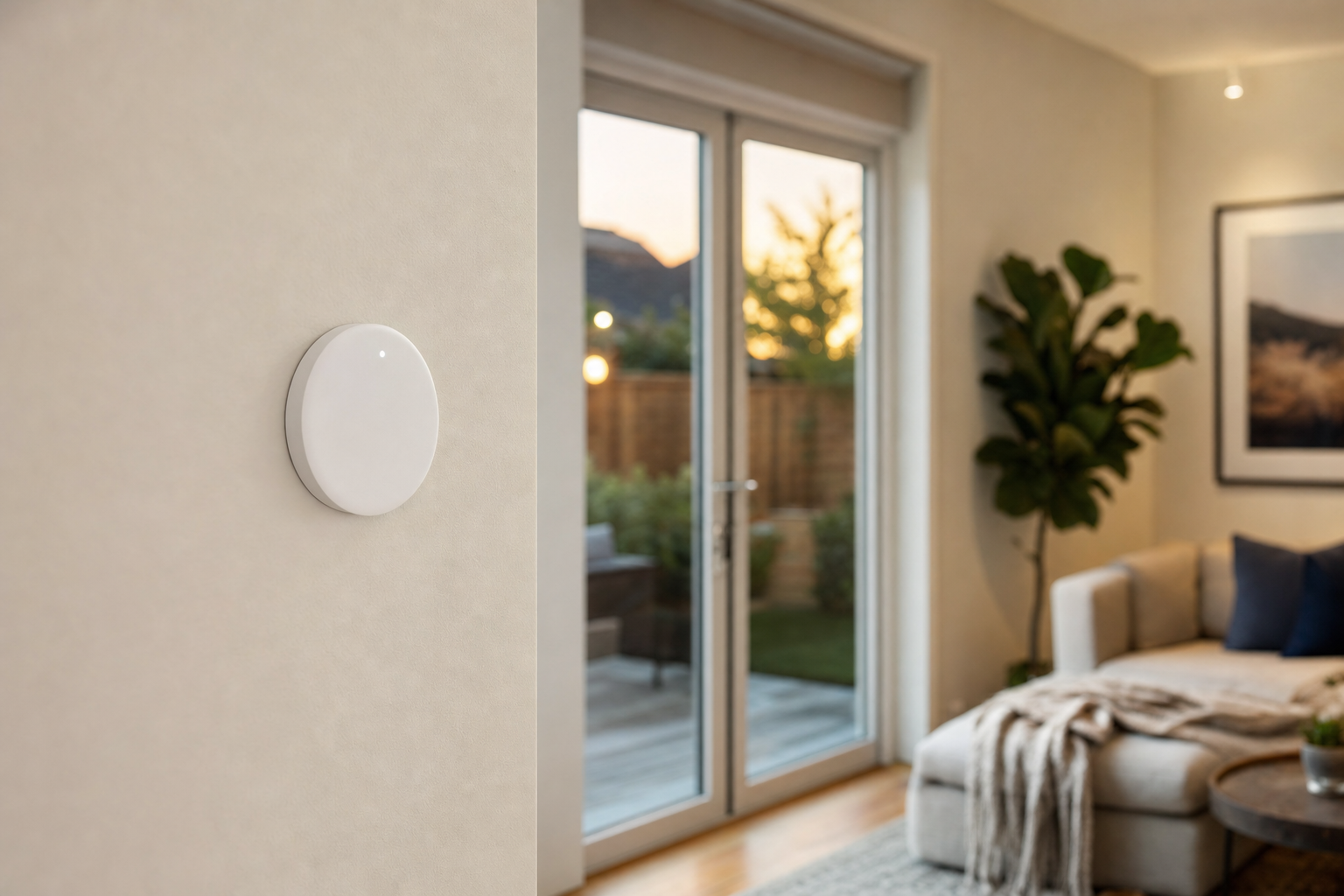
The best glass break sensor for most homes is Ring’s newest Glass Break Sensor: it costs about $40, works on its own over Amazon Sidewalk or as part of a Ring Alarm system, and listens for the sound of breaking glass across a whole room. If you already have an alarm system, buy the sensor made for it: SimpliSafe and eufy sensors only work with their own base stations. For Apple Home, the Aqara Vibration Sensor is the option that works, through an Aqara hub.
A glass break sensor covers what door and window sensors can’t. A contact sensor only reacts when a window opens, so someone who breaks the glass and climbs through a fixed window, a sliding door or a pane next to the lock doesn’t trigger it. This guide compares five options by the system they work with. If you’re still choosing the system itself, start with our guide to the best DIY home security systems.
Quick Recommendations
- Ring Glass Break Sensor — Best overall. Works over Amazon Sidewalk without a base station, or with Ring Alarm.
- SimpliSafe Glassbreak Sensor — Best for SimpliSafe. A 20-foot range and three sensitivity levels.
- eufy Glass Break Sensor E10 — Best without a monthly fee. App alerts through a eufy HomeBase without a subscription.
- Aqara Vibration Sensor — Best for Apple Home. A small vibration sensor for one window, through an Aqara hub.
- Feit Electric Wi-Fi Glass Break Sensor — Best Wi-Fi option. Connects to your router, with a built-in 85 dB alarm.
Top Choices at a Glance
| Product | Works With | Detection | Approx. Price | Best For |
|---|---|---|---|---|
| Ring Glass Break Sensor | Ring app, Ring Alarm | Sound, whole room | ~$40 | Most homes |
| SimpliSafe Glassbreak Sensor | SimpliSafe Gen 3 | Sound, up to 20 ft | ~$40 | SimpliSafe owners |
| eufy Glass Break Sensor E10 | eufy HomeBase | Sound, up to 25 ft | ~$60 | No monthly fee |
| Aqara Vibration Sensor | Aqara hub, Apple Home | Vibration, one pane | ~$20 | Apple Home |
| Feit Electric Wi-Fi Glass Break Sensor | Feit Electric app | Sound and vibration, on the glass | ~$30 | No hub or system |
The three acoustic sensors cover a room each, while the Aqara and the Feit are stuck on (or next to) one window.
Compatibility Matrix
| Product | HomeKit | Alexa | Google Home | Matter | Thread | Hub Required | Wiring/Power |
|---|---|---|---|---|---|---|---|
| Ring Glass Break Sensor | No | Not stated | No | No | No | No (Amazon Sidewalk), or a Ring Alarm base station | 3 AA batteries |
| SimpliSafe Glassbreak Sensor | No | With a plan | With a plan | No | No | SimpliSafe Gen 3 base station | Lithium battery |
| eufy Glass Break Sensor E10 | No | Not stated | Not stated | No | No | eufy HomeBase | 2 CR123A batteries |
| Aqara Vibration Sensor | Yes (Aqara hub) | Yes (Aqara hub) | Not stated | Not stated | No | Aqara hub | Coin battery |
| Feit Electric Wi-Fi Glass Break Sensor | No | Not stated | Not stated | No | No | No (Wi-Fi) | 2 AAA batteries |
Only the Aqara works with Apple Home, so it’s the option for HomeKit users. The SimpliSafe and the eufy don’t work without their brand’s base station, and the Ring needs either Sidewalk coverage at your home or a Ring Alarm base station.
The Best Glass Break Sensors in 2026
Ring Glass Break Sensor — Best Overall

Ring’s newest glass break sensor is the easiest to add to almost any home: you don’t need a base station, and it also works with Ring Alarm if you have one.
Best for: Ring users, and anyone who wants a room-wide sensor without buying a full alarm system.
What stands out in real use
This model arrived with Ring’s new Sidewalk sensors at CES 2026. The older Ring Alarm glass break sensor needed the Ring Alarm base station; this one connects over Amazon Sidewalk, the shared low-power network that some Echo speakers and Ring devices provide, so it reaches the Ring app without a hub. Ring says it stays connected even if your internet goes down, and that it uses AI to recognize the sound of breaking glass and filter out common household noise. If you already have Ring Alarm, it can join the base station over Z-Wave instead and work like any other alarm sensor (Ring sets glass break sensors to detect in Home and Away modes by default, not when disarmed).
Key specs
- Amazon Sidewalk or Z-Wave (Ring Alarm base station)
- 3 AA batteries, up to 2 years
- Indoor, 32 to 120°F
- Wall or ceiling mount, screws and anchors included
- 24/7 Pro Monitoring with a Ring subscription
Pros
- Doesn’t need a base station
- Stays connected when Wi-Fi drops
- Also works as part of Ring Alarm
- Costs about $40
Cons
- Needs Amazon Sidewalk coverage, which varies by location, if you don’t have Ring Alarm
- Doesn’t work with Apple Home or Google Home
- Ring doesn’t publish a detection range for this model
Installation and compatibility notes
Set it up in the Ring app first, then mount it. Ring’s placement guide says at least 7 feet above the floor and within 25 feet of the windows or glass doors, and not on a shelf or table where things get moved around. Keep the plans in mind: Pro Monitoring and arming from the app need a Ring subscription, and on a Ring Alarm system without one, the siren sounds but nobody gets a phone alert. Our guide on whether you need a subscription for Ring explains the current plans.
Price: ~$40
SimpliSafe Glassbreak Sensor — Best for SimpliSafe

If your home already has a SimpliSafe system, this is the glass break sensor to add: it pairs with the base station and has the most adjustable sensitivity of the options in this guide.
Best for: SimpliSafe Gen 3 owners who want to cover large windows or a sliding door.
What stands out in real use
SimpliSafe’s sensor has a small microphone that listens for two sounds in a row: the thump of something hitting the glass, then the sound of it breaking. SimpliSafe says that two-step check is why a dropped drinking glass shouldn’t set it off. It covers up to 20 feet, and SimpliSafe says one sensor usually covers an average room with about three windows. A switch under the battery sets the sensitivity to low, medium or high, which helps if the first spot you choose gives false alarms. Testing is simple: put the system in Test Mode and clap in the room, and the base station announces the sensor.
Key specs
- Up to 20 feet detection range
- Low, medium and high sensitivity
- Lithium battery, rated at three to five years
- Peel-and-stick, screws, or stands on a shelf
- SimpliSafe Gen 3 base station required
Pros
- Three sensitivity levels
- Easy clap test in Test Mode
- Can sit on a shelf instead of being mounted
- Long battery life
Cons
- Works only with a SimpliSafe Gen 3 system
- Alexa and Google Assistant need a SimpliSafe monitoring plan
- No support for Apple Home
Installation and compatibility notes
SimpliSafe recommends a shelf or wall within 20 feet of the windows you want to cover, and not in the kitchen, where clinking glassware can cause false alarms. You add it in the SimpliSafe app. Professional monitoring needs one of SimpliSafe’s paid plans. If you’re choosing between the two big DIY brands, our SimpliSafe vs Ring Alarm comparison covers the systems themselves.
Price: ~$40
eufy Glass Break Sensor E10 — Best Without a Monthly Fee

The E10 is the best choice for eufy camera and alarm owners: it works through the eufy HomeBase you may already have, and you don’t need a subscription to get its alerts.
Best for: eufy users who want app alerts without paying every month.
What stands out in real use
The E10 listens up to 25 feet and is designed to detect six types of glass: plate, coated, laminated, tempered, wired and dual pane. Sensitivity is adjustable in the eufy Security app, and in Home Mode it stops reporting events while you’re at home. It also has a tamper alarm that goes off if someone tries to remove it. eufy says it can be up to 656 feet from the HomeBase in open air.
Key specs
- Up to 25 feet detection range
- 2 CR123A batteries, about 2 years
- Tamper alarm
- Adhesive or screw mounting
- eufy HomeBase Mini, 2, 3 or Pro required
Pros
- App alerts without a subscription
- Six glass types listed
- Adjustable sensitivity and modes in the app
- Tamper alarm
Cons
- Needs a eufy HomeBase with up-to-date firmware
- Highest price of these five
- eufy alarm sensors don’t appear in Apple Home
Installation and compatibility notes
Update the HomeBase first: eufy lists a minimum firmware for each model, and the HomeBase 2 must be one released after 2021. eufy suggests mounting it opposite or next to the windows, with a clear line of sight to the glass and away from TVs and speakers. To test it, hold the test button for 2 seconds and play a glass-breaking sound near it, then check the app for the event. 24/7 professional monitoring is a separate eufy plan, if you want it.
Price: ~$60
Aqara Vibration Sensor — Best for Apple Home

The Aqara is a different kind of glass break detector: it doesn’t listen for sound, it feels the vibration on the window it’s attached to, and it’s the only option in this guide that works with Apple Home.
Best for: Apple Home users with an Aqara hub who want to protect one or two specific windows.
What stands out in real use
You attach it to the window you want to protect, and it reports vibration, tilt and drops. When it’s triggered, the Aqara hub can sound its alarm and send a notification to your phone, and in Apple Home you can use it in automations, such as turning on the lights. Sensitivity is adjustable, which matters, because a vibration sensor can also react to a knock or a slammed window. Aqara says local automations keep working when your Wi-Fi is down, as long as the hub has power.
Key specs
- Detects vibration, tilt and drop
- Zigbee, Aqara hub required
- Apple Home and Alexa through the Aqara hub
- Coin battery, about 2 years
- Adjustable sensitivity
Pros
- Works with Apple Home
- Lowest price in this guide
- Small enough for a window frame
- Local automations without Wi-Fi
Cons
- One sensor protects one pane, not a whole room
- A knock on the window can trigger it
- Needs an Aqara hub, sold separately
Installation and compatibility notes
Pair it with the Aqara app and an Aqara hub first; the hub is what brings it into Apple Home. Start on a lower sensitivity and raise it only if a firm tap on the glass doesn’t register. For alarm-style automations, our guide to HomeKit automations shows how to set them up.
Price: ~$20
Feit Electric Wi-Fi Glass Break Sensor — Best Wi-Fi Option

The Feit is the simplest option if you don’t have an alarm system or Sidewalk coverage: it connects to your Wi-Fi and has its own siren.
Best for: Protecting a single sliding door or window without buying a hub.
What stands out in real use
It attaches to the glass door or window and reacts to the sound of glass breaking or to vibration. When it’s triggered, it sounds its built-in 85 dB alarm and sends a push notification through the Feit Electric app. In the same app, Smart Scenes can turn on Feit cameras or lights at the same time. It has only a few owner reviews on Amazon so far, so test it after you install it.
Key specs
- Detects sound and vibration
- Wi-Fi, no hub
- Built-in 85 dB alarm
- 2 AAA batteries
- 2.9 x 2.9 x 0.5 inches, indoor use
Pros
- No hub or base station
- Built-in siren
- Works with Feit Electric cameras and lights
Cons
- Feit Electric app only; Feit doesn’t list Alexa or Google Home support
- Covers the glass it’s attached to, not a whole room
- Few owner reviews so far
Installation and compatibility notes
Mount it on the window or door within range of your Wi-Fi router, since it connects directly to your network. It’s battery powered and doesn’t need any wiring, which also makes it a good fit for renters.
Price: ~$30
Acoustic vs Vibration Glass Break Detectors
There are two kinds of glass break sensors, and they’re installed in different ways.
Acoustic sensors (Ring, SimpliSafe, eufy) are small microphones on a wall or ceiling. They wait for two sounds within a very short time: the low thud of something hitting the glass and the high-pitched sound of it shattering. Because they need both, they’re less likely to go off for everyday noises, and one sensor can cover several windows in a room.
Vibration (shock) sensors (Aqara, and the Feit, which also listens for sound) go on the glass or the frame. They protect only that window, and they can react to a knock or a slammed sash, so sensitivity settings matter more.
A glass break sensor isn’t meant to catch a window that’s simply opened. That’s what contact sensors are for, so most homes use both: contact sensors on the doors and windows that open, and a glass break sensor for the rooms with big glass. Our guide to the best smart door sensors covers the first part.
Where to Put a Glass Break Sensor and How to Test It
Placement decides how well an acoustic sensor works.
- Distance: Stay within the maker’s range: 20 feet for SimpliSafe and 25 feet for eufy, and Ring’s guide says within 25 feet. eufy recommends closer, under about 6.5 feet, when you can.
- Height and line of sight: Ring suggests at least 7 feet up, and eufy recommends a clear line of sight to the glass, opposite or next to the window.
- Curtains: SimpliSafe warns that heavy curtains can muffle the sound the sensor listens for. Mount it on the room side, where nothing blocks it.
- Noise: Keep it away from kitchens, TVs and speakers, the most common causes of false alarms.
Don’t break a window to test it. SimpliSafe uses a clap test in Test Mode, eufy has a test button plus a glass-breaking sound played from your phone, and alarm companies use glass break simulators. Then check that the alert reached your phone. If you’d rather not get alerts while you’re home, set the sensor to report only in Away mode.
Conclusion
Ring’s newest Glass Break Sensor is the best glass break sensor for most homes: it works without a base station over Amazon Sidewalk, joins Ring Alarm if you have it, and costs about $40. If you already have SimpliSafe or eufy, buy their sensor, since each only works with its own base station; the eufy E10 is the one to get if you don’t want a monthly fee. Apple Home users should look at the Aqara Vibration Sensor, and the Feit Electric sensor covers a single window over Wi-Fi without a hub.
What is the best glass break sensor?
Ring’s newest Glass Break Sensor is the best choice for most homes. It costs about $40, works over Amazon Sidewalk without a base station or with a Ring Alarm system, and listens for breaking glass across a whole room. If you already have SimpliSafe or eufy, buy their sensor instead.
Does the Ring Alarm glass break sensor need a base station?
Not the newest model. Ring’s newest Glass Break Sensor can connect over Amazon Sidewalk without a base station, as long as your home has Sidewalk coverage. It can also join a Ring Alarm base station over Z-Wave. Pro Monitoring and arming from the app need a Ring subscription.
How does a glass break detector work?
An acoustic glass break detector is a small microphone that listens for two sounds within a very short time: the low thud of something hitting the glass and the high-pitched sound of it breaking. A vibration sensor is attached to the glass instead and reacts to shocks on that one window.
Where should you put a glass break sensor?
Mount an acoustic sensor within its range of the windows, usually 20 to 25 feet, with nothing blocking the sound. Ring suggests at least 7 feet up. Keep it away from kitchens, TVs and speakers, and make sure heavy curtains don’t cover the glass.
Do glass break sensors work with Apple Home?
Ring, SimpliSafe and eufy glass break sensors don’t work with Apple Home. The Aqara Vibration Sensor does, through an Aqara hub, so you can use it in Home app automations. It detects vibration on one window rather than the sound of breaking glass.

Written by Evan Mercer
Founder & Lead Researcher, Smart Home Matrix
Evan digs through spec sheets, firmware changelogs, and thousands of owner reviews so you don’t have to. Every guide starts with a compatibility check and ends with picks he would install in his own home. Read more about Evan and this site, or see exactly how we choose products.