
The best radon detector for most homes is the Airthings View Radon: a continuous radon monitor with Wi-Fi, a screen you can read from across the room and alerts on your phone when levels rise. Radon is a radioactive gas you can’t see or smell, and the EPA recommends fixing a home when the level reaches 4 pCi/L or more, so the only way to know your home’s level is to test for it.
Below are six options for different homes and budgets: a Wi-Fi monitor for about $100, one that gives a first reading in 10 minutes, one that works without an app, a monitor that also tracks the rest of your air and a radon test kit for about $22. If you also want to track CO2 and particles, our indoor air quality monitor guide covers those devices.
Quick Recommendations
- Airthings View Radon — Best overall. Wi-Fi, a clear screen and phone alerts, and it works with Alexa and Google Assistant.
- X-Sense XR0A-iR — Best budget. A Wi-Fi radon monitor with app alerts for about $100.
- Aranet Radon Plus — Best for fast results. A first reading in about 10 minutes and up to 7 years on two AA batteries.
- Airthings Corentium Home 2 — Best without an app. Shows short- and long-term averages on its screen, and you don’t need a phone.
- Airthings View Plus — Best for radon and air quality. Radon plus PM2.5, CO2 and VOCs in one monitor.
- AirChek 43237-2 — Best radon test kit. A charcoal kit for a quick first test, with lab analysis included.
At-a-Glance Comparison
| Product | Ecosystem | Key Feature | Approx. Price | Best For |
|---|---|---|---|---|
| Airthings View Radon | Alexa, Google | Wi-Fi, e-paper screen | ~$220 | Best overall |
| X-Sense XR0A-iR | X-Sense app | Wi-Fi, app alerts | ~$100 | Lowest price monitor |
| Aranet Radon Plus | Home Assistant | First reading in 10 minutes | ~$209 | Fast results |
| Airthings Corentium Home 2 | Airthings app | Averages on screen | ~$180 | Use without an app |
| Airthings View Plus | Alexa, Google | Radon + PM2.5 + CO2 + VOC | ~$330 | Whole-air monitoring |
| AirChek 43237-2 | None | 3 to 7 day lab test | ~$22 | One-time test |
Compatibility Matrix
| Product | HomeKit | Alexa | Google Home | Matter | Thread | Hub Required | Wiring/Power |
|---|---|---|---|---|---|---|---|
| Airthings View Radon | No | Yes (reads levels) | Yes (reads levels) | No | No | No (Wi-Fi built in) | 6 AA batteries or USB |
| X-Sense XR0A-iR | No | No | No | No | No | No (Wi-Fi built in) | 3 AA batteries |
| Aranet Radon Plus | No | No | No | No | No | No (Bluetooth to your phone) | 2 AA batteries |
| Airthings Corentium Home 2 | No | Not stated | Not stated | No | No | Optional Airthings hub for remote access | 2 AA batteries |
| Airthings View Plus | No | Yes (reads levels) | Yes (reads levels) | No | No | No (Wi-Fi built in) | 6 AA batteries or USB-C |
| AirChek 43237-2 | No | No | No | No | No | No | None (mail-in kit) |
None of these devices works with Apple Home or Matter, so plan to check radon in the maker’s app. The two Airthings View monitors work with Alexa and Google Assistant, which can read the levels aloud, and the Aranet Radon Plus is the best choice if you use Home Assistant.
The Best Radon Detectors for 2026
Airthings View Radon — Best Overall

The View Radon is the best choice for most homes. It connects to your Wi-Fi, shows radon on a screen you can read at a glance and sends an alert to your phone when the level goes up, even when you’re away.
Best for: Most homes, especially if you want to check a basement or a lower floor without walking down to it.
What stands out in real use
The 2.9-inch e-paper screen shows the readings you choose in the app, and a red, yellow or green glow tells you the level at a glance. Like every Airthings monitor, it reports radon as a 24-hour average, and Airthings says the first days of samples are likely to be inaccurate, so give it about a week before you read much into the numbers. After that, the app shows how radon rises and falls with the seasons. You can also ask Alexa or Google Assistant for the latest reading.
Key specs
- Measures radon, temperature and humidity
- 2.4GHz Wi-Fi and Bluetooth (you don’t need a hub)
- 2.9″ e-paper screen with a color glow indicator
- 6 AA batteries (up to 3 years) or USB power
- Within about 10% at 5.4 pCi/L after 7 days, about 5% after 2 months
Pros
- Phone alerts and history from anywhere
- Easy-to-read screen
- Works with Alexa and Google Assistant
- Runs on batteries, so you can place it away from an outlet
Cons
- Readings take about a week to settle
- Doesn’t work with Apple Home or Matter
- Alexa and Google can only read the levels, not use them in automations
Installation and compatibility notes
Place it in the lowest level of your home where you spend time, away from drafts and exterior walls. Plugged in over USB, it also acts as a hub for Airthings Wave monitors, so you can add them in other rooms. Airthings offers a free 5-year extended warranty if you register it within 30 days.
Price: ~$220
X-Sense XR0A-iR — Best Budget

For about $100, the XR0A-iR gives you what most budget monitors don’t: Wi-Fi. The X-Sense app sends you a notification when radon changes, so you don’t have to go and check the screen.
Best for: Tight budgets, and anyone who wants phone alerts without paying for an Airthings View.
What stands out in real use
X-Sense says you get results within 24 hours. The LCD shows the current level with trend arrows that tell you if radon is going up, going down or staying stable, plus short- and long-term averages. In the app, you can export your history as a PDF, XLSX or CSV report, which is useful if you talk to a mitigation contractor. To check another room, you move the detector and press the reset button to start a new session.
Key specs
- Measures radon, temperature and humidity
- 2.4GHz Wi-Fi (you don’t need a base station)
- LCD with current level, averages and trend arrows
- 3 AA batteries, up to 2 years
- Within ±10% at 5.4 pCi/L after 7 days
Pros
- Lowest price for a Wi-Fi radon monitor here
- App notifications when radon changes
- Exports reports from the app
- One-button reset to test room by room
Cons
- Only works in the X-Sense app (doesn’t support Alexa, Google, Apple Home or Home Assistant)
- Doesn’t work with X-Sense’s SBS50 base station
- First result takes up to a day
Installation and compatibility notes
It needs a 2.4GHz Wi-Fi network at the spot where you place it. It sits on a shelf or table, so you don’t need to install anything.
Price: ~$100
Aranet Radon Plus — Best for Fast Results
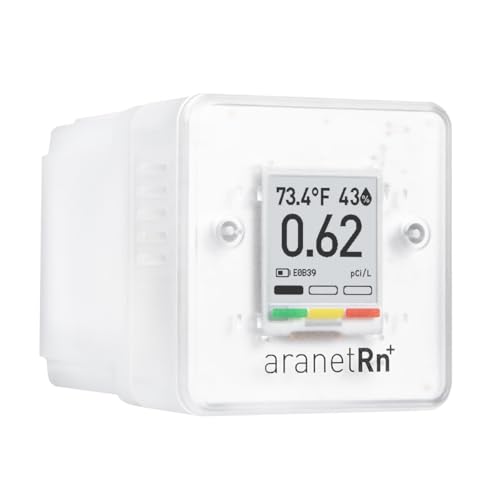
The Radon Plus gives you a first reading in about 10 minutes and a stable one within an hour, while most monitors need a day. It runs for up to 7 years on two AA batteries.
Best for: Checking several rooms quickly, and Home Assistant users.
What stands out in real use
The radon reading updates every 10 minutes, and a scroll wheel on the side switches the e-ink screen between the current level and the 24-hour, 7-day and 30-day averages. Green, yellow and red bars show the risk level, and you can turn on a buzzer that sounds above a level you choose. Breathe Safe Air called the Aranet Home app the best radon monitor app it has reviewed, and you don’t need an account to use it. The monitor stores 30 days of data, so your phone only needs to sync once in a while.
Key specs
- Measures radon, temperature, humidity and air pressure
- Bluetooth to the Aranet Home app (doesn’t have Wi-Fi)
- E-ink screen with 24-hour, 7-day and 30-day averages
- 2 AA batteries, up to 7 years
- First reading in about 10 minutes, updates every 10 minutes
Pros
- Fastest results of the monitors here
- Very long battery life
- Works with Home Assistant over Bluetooth
- Optional buzzer with an adjustable threshold
Cons
- Bluetooth only, so you can’t check it or get alerts away from home
- Doesn’t work with Alexa, Google or Apple Home
- Costs more than the Corentium Home 2
Installation and compatibility notes
Aranet recommends the lowest regularly used level of your home, about 0.8 to 2 meters (2.5 to 6.5 feet) above the floor. For Home Assistant, turn on “Smart Home integration” in the Aranet Home app and keep the monitor within Bluetooth range of your Home Assistant device.
Price: ~$209
Airthings Corentium Home 2 — Best Without an App

The Corentium Home 2 is the simplest option here: put in two AA batteries and it shows the radon level on its screen. You don’t need Wi-Fi, a phone or an account.
Best for: Anyone who wants a long-term radon reading without another app, and anyone who’d rather not use an app.
What stands out in real use
One button cycles the LCD through the 24-hour, 7-day, 30-day and long-term (up to one year) radon averages, plus temperature and humidity. The first 24-hour average appears after one full day. If you do want graphs, the Airthings app connects over Bluetooth, and with an Airthings hub or a View monitor you also get remote access and alerts. Good, fair or poor indicators on the screen tell you what the number means.
Key specs
- Measures radon, temperature and humidity
- Bluetooth (optional), connects to an Airthings hub or View monitor for remote access
- LCD with 24-hour, 7-day, 30-day and long-term averages
- 2 AA batteries, up to 3 years
- Within 10% at 5.4 pCi/L after 7 days
Pros
- Works on its own, with no setup
- Long-term averages right on the screen
- Up to 3 years on two AA batteries
- Free 5-year warranty when you register it
Cons
- No alerts or remote access without an Airthings hub
- First reading takes a day
- Doesn’t work with Apple Home or Matter
Installation and compatibility notes
It’s small enough to move from room to room, but each new spot needs about a week before the averages mean much. Keep it on a shelf or table in the lowest lived-in level of your home.
Price: ~$180
Airthings View Plus — Best for Radon and Air Quality

The View Plus measures radon along with PM2.5, CO2 and VOCs, so one device covers the main things worth tracking in a home’s air. It’s also the best overall option in our air quality monitor guide.
Best for: Homes that want radon and everyday air quality on one screen, such as a living room on the ground floor.
What stands out in real use
The e-ink screen shows two readings at a time, and you choose which ones in the app. CO2 tells you when a room needs fresh air, PM2.5 picks up smoke from cooking or wildfires and radon builds a long-term average in the background. Like the View Radon, it connects over Wi-Fi, sends alerts to your phone and works with Alexa and Google Assistant.
Key specs
- Measures radon, PM2.5, CO2, VOCs, temperature, humidity and air pressure
- 2.4GHz Wi-Fi and Bluetooth (you don’t need a hub)
- E-ink screen with two readings at a time
- 6 AA batteries (up to 2 years) or USB-C power
- Works with Alexa, Google Assistant and IFTTT
Pros
- Seven sensors in one monitor
- Phone alerts and history from anywhere
- Acts as a hub for Airthings Wave monitors on USB-C power
Cons
- The most expensive monitor here
- Doesn’t work with Apple Home or Matter
- Reviewers report shorter battery life with faster sampling
Installation and compatibility notes
Radon is highest at the lowest level of a home, while CO2 matters most where people spend time, so place it in a ground-floor room you use every day. If radon is your only concern, the View Radon costs about $110 less.
Price: ~$330
AirChek 43237-2 — Best Radon Test Kit

The AirChek kit is the least expensive way to find out if your home has a radon problem. You leave the charcoal canister out for 3 to 7 days, then mail it to the lab in the prepaid mailer.
Best for: A first test before you buy a monitor, and homeowners who only want a one-time answer.
What stands out in real use
The activated charcoal absorbs radon from the air during the test. AirChek’s price includes the lab analysis and the USPS return postage, and you check your result online with the kit’s serial number. It’s a short-term test, so it tells you the level for those days, not the year-round average: if it comes back at 4 pCi/L or higher, the EPA recommends a follow-up test.
Key specs
- Short-term activated charcoal test, 3 to 7 days
- Lab analysis and return postage included
- Results online with the kit’s serial number
Pros
- About $22, including the lab
- You don’t need power, Wi-Fi or an app
- Easy to use for a first screening
Cons
- One result, not continuous monitoring
- The kit has to reach the lab within about 11 days after the test
- Not sold to New Jersey residents
Installation and compatibility notes
Close windows and outside doors 12 hours before the test and keep them closed during it. Place the kit at least 20 inches above the floor in a room you use on the lowest lived-in level, not in a kitchen, bathroom or damp basement.
Price: ~$22
Radon Test Kit or Radon Monitor?
A radon test kit gives you one result for a few days. It costs little, and it’s how the EPA suggests you start: take a short-term test, and if the result is 4 pCi/L or higher, follow up with a long-term test or a second short-term test. The EPA’s radon health risk page explains the action levels, including why it suggests considering a fix between 2 and 4 pCi/L. Our guide on how to test for radon explains each step, from where to place the kit to what your result means.
A continuous radon monitor keeps measuring for as long as you leave it in place. Radon rises and falls with the weather and the seasons, so months of readings tell you more than a few days. It also keeps working after a fix: if you install a mitigation system, a monitor shows you whether the level came down and stays down. For a home sale, buyers may still ask for a test from a certified professional.
How to Choose a Radon Detector
How fast you need a number. The Aranet Radon Plus gives a first reading in about 10 minutes. The Airthings monitors report a 24-hour average and the X-Sense gives results within 24 hours, so they need up to a day for the first number and about a week before it settles.
Wi-Fi or Bluetooth. Wi-Fi monitors (the two Airthings View models and the X-Sense) send alerts to your phone wherever you are. Bluetooth monitors only update when your phone is nearby, which is fine if you check the screen anyway.
A screen you can read. Every monitor here has a screen, so you can see the level without opening an app. Long-term averages are the number to watch, since the EPA bases its advice to fix a home on a long-term result, and the Corentium Home 2, the Aranet and the X-Sense show them on the screen.
Battery life. All of these run on AA batteries, from about 2 years (X-Sense, View Plus) to up to 7 years (Aranet). The View monitors can also run on USB power.
Extra sensors. Most radon detectors also show temperature and humidity, which helps in a basement. If you want more, the View Plus adds PM2.5, CO2 and VOCs. Our guide on what humidity should be in your house explains which humidity readings to aim for.
Where to place it. Put the detector in the lowest level of your home where you spend time, away from drafts, heat and exterior walls. A basement is also a good place for water leak sensors. And a radon monitor doesn’t replace a smoke or CO alarm: our smart smoke and CO detector guide covers those.
Conclusion
The Airthings View Radon is the best radon detector for most homes: Wi-Fi, a clear screen and alerts on your phone. The X-Sense XR0A-iR gives you Wi-Fi alerts for about $100, and the Aranet Radon Plus is the one to choose for fast readings or Home Assistant. Choose the Corentium Home 2 if you don’t want an app, the View Plus to track radon and the rest of your air, and the AirChek kit for a quick first test.
What is the best radon detector?
For most homes, the Airthings View Radon is the best radon detector. It connects to Wi-Fi, shows radon on an e-paper screen and sends phone alerts when levels rise. On a budget, the X-Sense XR0A-iR offers Wi-Fi alerts for about $100.
What radon level is dangerous?
The EPA recommends fixing your home if radon is 4 pCi/L or higher, and considering a fix between 2 and 4 pCi/L. The average indoor level in the US is about 1.3 pCi/L, and the EPA says even levels below 4 pCi/L carry some risk.
Are radon test kits accurate?
A short-term radon test kit measures the level for the days it was out, but radon changes with weather and seasons. That’s why the EPA recommends a follow-up test if the first result is 4 pCi/L or higher: a long-term test, or a second short-term test if you need results quickly.
Is a continuous radon monitor better than a test kit?
A continuous radon monitor keeps measuring, so it shows how radon changes over months and whether a mitigation system is working. A test kit costs much less and is a good first step: if the result is high, a monitor helps you follow the level over time.
Where should I put a radon detector?
Place it in the lowest level of your home where you spend time, such as a used basement or the ground floor. Keep it away from drafts, heat sources, exterior walls, kitchens and bathrooms, and, for most monitors, give it about a week before you rely on the readings.
Do radon detectors work with Alexa or Google Home?
The Airthings View Radon and View Plus work with Alexa and Google Assistant, which can read your latest radon level aloud. None of the radon detectors in this guide works with Apple Home or Matter.

Written by Evan Mercer
Founder & Lead Researcher, Smart Home Matrix
Evan digs through spec sheets, firmware changelogs, and thousands of owner reviews so you don’t have to. Every guide starts with a compatibility check and ends with picks he would install in his own home. Read more about Evan and this site, or see exactly how we choose products.