
The Honeywell T9 vs T10 question looks like a choice between two similar touchscreen thermostats, and in a way it is. They’re the same size, use the same wall plate, and both work with wireless room sensors. The real difference is who they’re for: the T9 was Honeywell Home’s do-it-yourself thermostat, while the T10 Pro was the version sold only through HVAC contractors, with extra controls for humidifiers, dual-fuel systems and other equipment.
Many comparisons online still treat both as current, but both models are now discontinued. This guide explains how the T9 and T10 differ (useful if you own one, found one, or have a contractor quote in hand), what replaced each, and what to buy today.
Honeywell T9 vs T10: The Short Answer
Quick answer: the T9 is the DIY thermostat for ordinary furnace, AC and heat pump systems. The T10 Pro adds control of a humidifier, dehumidifier or ventilator, dual-fuel support and a longer warranty, but it’s installed by a pro. Honeywell doesn’t sell either one anymore: the X8S replaced the T9, and the T10 line moved to the T10+ Pro and then the ElitePRO S1200.
Here’s where each model stands in late 2026:
- T9: discontinued. Honeywell’s product page says it’s no longer available for sale, and Honeywell’s store names the X8S with a room sensor as its replacement.
- T10 Pro: discontinued. Resideo, the company that makes Honeywell Home thermostats, says in its parts catalog that it was upgraded to the T10+ Pro.
- T10+ Pro: also marked discontinued on Honeywell Home’s site. HVAC distributors list the ElitePRO S1200 as the replacement for both T10 kits, and some still have leftover T10+ stock.

What the T9 Does Best
The T9 was built for homeowners. The installation guide walks you through it step by step, and the kit with a room sensor includes a C-wire adapter for homes that don’t have a common wire (the thermostat needs 24V power and has no battery).
Its main feature is room sensors. The T9 works with up to 20 wireless sensors that report temperature, humidity and motion, with a range of up to 200 feet. You can set it to average only the rooms where someone is moving (Active Rooms) or the rooms you choose (Selected Rooms), and you can change that for each part of the schedule. That’s how it evens out a cold bedroom or a hot upstairs office.
It also connects to both 2.4 GHz and 5 GHz Wi-Fi and works with Apple Home, Alexa and Google Assistant.
The limits show up once your system has more than heating and cooling. In the T9’s own manual, the U terminal is listed as “Not used”, so it can’t run a whole-home humidifier, dehumidifier or ventilator. Its setup menu has no dual-fuel option, and it can’t use a wired outdoor sensor (outdoor temperature comes from the internet). The warranty is two years.
What the Honeywell T10 Pro Does Best
The Honeywell T10 Pro looks almost identical, but Honeywell says it’s sold through professional HVAC installers and gives them more ways to match the thermostat to your equipment. In practice, that means a few things the T9 can’t do:
- One air-quality device. A U relay runs a humidifier, dehumidifier or ventilator, with humidity setpoints from the thermostat.
- Dual fuel. It can manage a heat pump with a gas or oil furnace as backup.
- Wired sensors. It has terminals for a wired indoor or outdoor sensor, plus an input for a heat pump fault signal.
- A longer warranty. Five years instead of two.
Its RedLINK room sensors do the same job as the T9’s: temperature, humidity and motion, up to 20 per thermostat, with the same priority options.
The T10+ Pro added more. Paired with Honeywell’s Equipment Interface Module (EIM), it controls a humidifier, dehumidifier and ventilator together, adds a stage of heat, and supports a wireless outdoor sensor, supply and return air sensors, and alerts for things like a full drain pan.
What the T10 doesn’t include is a C-wire adapter. It needs a common wire, and Honeywell sells the adapter separately.
Honeywell T9 vs T10 Side by Side
| Factor | T9 | T10 Pro / T10+ Pro |
|---|---|---|
| Sold through | Retail stores (DIY) | HVAC contractors |
| Status | Discontinued | Discontinued |
| Heat pump stages | Up to 3 heat / 2 cool | Up to 3 heat / 2 cool (4/2 with T10+ and EIM) |
| Conventional stages | Up to 2 heat / 2 cool | Up to 2 heat / 2 cool (3/2 with T10+ and EIM) |
| Dual fuel | No | Yes |
| Humidifier, dehumidifier, ventilator | No | One device (all three with T10+ and EIM) |
| Room sensors | Up to 20 | Up to 20 (RedLINK) |
| Wired outdoor sensor | No | Yes |
| C-wire adapter in the box | Yes (sensor kit) | No |
| Wi-Fi | 2.4 and 5 GHz | 2.4 and 5 GHz |
| Apple Home, Alexa, Google | Yes | Yes |
| Matter | No | No |
| Warranty | 2 years | 5 years |
Humidity and ventilation control
This is the biggest difference. Both thermostats measure humidity, but only the T10 can act on it by switching a whole-home humidifier, dehumidifier or fresh-air ventilator. If your home has one of those wired to the old thermostat, a T9 can’t take over that job. Our guide to thermostats with humidity control covers the current models that can.
Heat pumps and dual fuel
On a standard heat pump with electric backup heat, the T9 and T10 handle the same number of stages. The difference is dual fuel: a heat pump paired with a gas or oil furnace. The T10 supports it, the T9 doesn’t, and neither does the X8S that replaced the T9. If that’s your system, see our heat pump thermostat guide for options that do.
Room sensors
The sensors work the same way on both: each supports 20 sensors with motion-based priority. The sensors aren’t interchangeable, though, and that matters when you replace the thermostat. Honeywell says newer T9 sensors and the T10+’s RedLINK 3.0 sensors pair with the X8S, while the original T10 sensor doesn’t. For how room sensors compare across brands, see our thermostats with remote sensors guide.
Installation and warranty
The T9 is a normal DIY install if you have a C wire or use the included adapter. The T10 is designed around a contractor: a professional install guide, an installer setup menu protected by a code, and Honeywell’s pro app. In return you get the five-year warranty, and the installer’s labor is part of the price. Our installation cost guide shows what pro installation typically runs.
Which Should You Choose?
Since neither is sold new by Honeywell, the right answer depends on where you’re starting from.
You already own a T9. There’s no reason to replace it while it works. It keeps working with Honeywell’s apps and smart home connections, and it does everything it did on day one. When it’s time to upgrade, the X8S is the direct replacement, and newer T9 sensors may pair with it (Honeywell says to try, since older units may not).
A contractor quoted you a T10 Pro or T10+ Pro. Ask whether it’s leftover stock and what warranty you get, then ask about the ElitePRO S1200, the current pro model. It handles dual fuel, up to two air-quality devices, Matter, and doorbell video, and like the T10 it’s priced and installed through a pro.
You’re buying new and installing it yourself. Skip both and look at the X8S. It’s Honeywell Home’s current top model, with Matter, a 5-inch screen, room sensors and video from Ring or First Alert doorbells. It can control a humidifier or ventilator, but it doesn’t support dual fuel. Our best Honeywell thermostats guide covers the rest of the lineup, and ecobee vs Honeywell compares it with the main alternative.
You found a T9 or T10 for sale. On Amazon, the remaining units come from third-party sellers, often at more than the original price (T10 Pro listings run around $340). A used or leftover unit may not carry Honeywell’s warranty, and a T10 still needs a C wire and is set up through an installer menu. Unless the price is low, the X8S is the safer buy.
What to Buy Instead
For most homes that would have bought a T9, these are the two ways to get the X8S. Both need a C wire, or a C-wire adapter if you don’t have one.
Honeywell Home X8S with Room Sensor — Best for New Installs
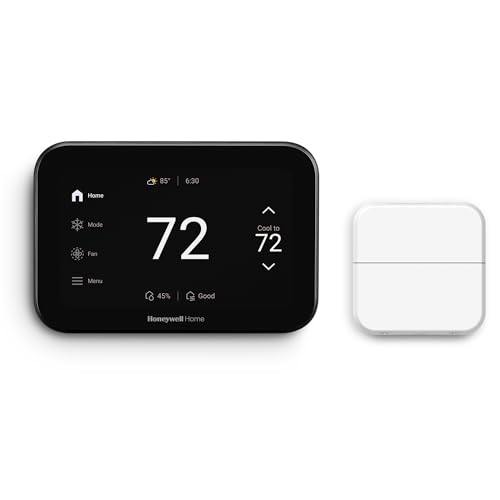
The kit to buy if you’re starting fresh. It includes one wireless room sensor, and you can add up to 20. Matter support means it works in Apple Home, Google Home and Alexa, though schedules and sensor settings stay in Honeywell’s app.
Best for: anyone replacing an older thermostat who wants room-by-room comfort.
Price: ~$260
Honeywell Home X8S — Best for T9 Owners

The same thermostat without a sensor in the box. If you’re upgrading from a T9, try pairing your existing T9 sensors first and buy extra sensors only if they don’t connect.
Best for: T9 owners upgrading, and single-room homes that don’t need a sensor.
Price: ~$240
The Bottom Line
The Honeywell T9 vs T10 choice was never really about features most people use every day. Both offered the same screen, sensors and smart home support. The T10 Pro added humidifier and ventilation control, dual fuel and a five-year warranty, in exchange for professional installation. Today both are discontinued, so if you’re buying, the X8S is the DIY choice and the ElitePRO S1200 is the contractor’s.
Is the Honeywell T9 discontinued?
Yes. Honeywell lists the T9 as discontinued and no longer available for sale. Its store names the X8S with a room sensor as the replacement.
What is the difference between the Honeywell T9 and the T10 Pro?
The T10 Pro is sold through HVAC contractors and adds control of a humidifier, dehumidifier or ventilator, dual-fuel support, wired sensor inputs and a five-year warranty. The T9 is a DIY thermostat with a two-year warranty. Both support up to 20 wireless room sensors.
Can I buy a Honeywell T10 Pro myself?
Honeywell sold the T10 Pro through professional HVAC installers, and the model is now discontinued. Leftover units turn up from third-party sellers, but they may not carry Honeywell’s warranty, and the setup is designed for an installer.
What replaced the Honeywell T10 Pro?
Resideo upgraded the T10 Pro to the T10+ Pro, which is now also discontinued. HVAC distributors list the ElitePRO S1200 as the replacement, a pro-installed thermostat with Matter, dual fuel and air-quality control.
Do T9 room sensors work with the Honeywell X8S?
Newer T9 sensors do. Honeywell says older T9 sensors may not pair with the X8S and suggests trying them first. The original T10 sensor (C7189R2002) doesn’t work with the X8S.
Does the Honeywell T9 work with a whole-home humidifier?
No. The T9’s manual lists its U terminal as not used, so it can’t control a whole-home humidifier, dehumidifier or ventilator. It shows indoor humidity and can remind you to change a humidifier pad, but that’s all.

Written by Evan Mercer
Founder & Lead Researcher, Smart Home Matrix
Evan digs through spec sheets, firmware changelogs, and thousands of owner reviews so you don’t have to. Every guide starts with a compatibility check and ends with picks he would install in his own home. Read more about Evan and this site, or see exactly how we choose products.