
A smart electrical panel is a breaker box that can measure and switch every circuit from an app. It shows you which circuits use the most power, lets you turn a circuit off from your phone, and can pause big loads like an EV charger so your home stays under the limit of its electrical service. SPAN is the best-known brand, and its panels cost $2,550 to $4,100 before installation.
That’s a lot of money for a breaker box, and most homes don’t need one. This guide explains how a smart panel works, what SPAN’s models cost, when one is worth it, and the cheaper alternatives that give you most of the same benefits.
Smart Electrical Panel at a Glance
| Feature | Smart electrical panel |
|---|---|
| What it replaces | Your existing breaker box (load center) |
| What it adds | Per-circuit energy data, remote on/off control, load management, backup control with a home battery |
| Who installs it | A licensed electrician (SPAN requires one of its authorized installers) |
| Hardware cost | $2,550 to $4,100 for SPAN, plus installation |
| Smart home support | Mostly the maker’s own app |
| Best for | Homes adding an EV charger, heat pump or battery on a limited electrical service |
How a Smart Panel Works
A smart panel still uses ordinary circuit breakers for protection: if a circuit overloads, the breaker trips exactly as it does today. What changes is everything around them. Each circuit gets a current sensor and a relay, and a small gateway connects the panel to your Wi-Fi or Ethernet and to the maker’s app.
That setup does four jobs:
- Shows energy use per circuit. You see what the dryer, the water heater or the basement freezer uses, live and over time.
- Switches circuits remotely. You can turn a circuit off from the app or put it on a schedule.
- Manages load. The panel watches the total current coming into the house and pauses the circuits you choose when it gets close to the limit.
- Controls backup power. With a home battery, you choose which circuits stay on during an outage.
Load management is the main reason smart panels exist. Many older homes have 100 or 125 amp service, and adding a Level 2 EV charger or an electric heat pump can push the calculated load past that. The usual fix is a service upgrade from the utility, which can be slow and expensive. A smart panel avoids that by making sure the big loads never run at full power at the same time: it might pause the EV charger for a few minutes while the oven and the dryer are running, then turn it back on.

The electrical code now allows for this. The 2023 National Electrical Code (section 220.70) lets an electrician use the energy management system’s maximum setpoint in the load calculation, instead of adding up every appliance at full power. However, not every city or county has adopted the 2023 code, and your local inspector decides whether a smart panel can replace a service upgrade in your home.
If you’re planning a heat pump, see our guide to the best thermostats for heat pumps too: a thermostat that limits the backup electric heat strips also keeps your peak load lower.
The SPAN Panel: Models and Prices
SPAN makes the best-known smart panel in the US. It currently sells five models. The number in each name is how many circuits the panel can switch and monitor.
| SPAN model | Controllable circuit spaces | Main breaker | Price (MSRP) |
|---|---|---|---|
| MLO 24 | 24 | 100 to 200 A | $2,550 |
| MAIN 16 | 16 | 100 to 200 A | $2,950 |
| MAIN 32 | 32 | 100 to 200 A | $3,500 |
| MLO 48 | 48 | 100 to 200 A | $3,850 |
| MAIN 40 | 40 | 100 to 200 A | $4,100 |
Prices are SPAN’s list prices, before installation, taxes and shipping.
“MAIN” models have a main breaker inside the panel. “MLO” stands for main lug only, for homes where the main breaker sits somewhere else, such as in a combined meter and breaker box outside. Your electrician will know which one your home needs. Each SPAN panel handles up to 200 amps, so a home with 400 amp service or more than 48 circuits needs more than one panel.
A few other details are worth knowing about the SPAN panel:
- It’s rated for indoor and outdoor use (NEMA 3R) and carries a 10-year warranty on the panel and 5 years on the Home Gateway.
- It’s certified to UL 3141, the newer safety standard for power control systems, in addition to the usual panel standards.
- It takes standard breakers from Square D (HOM), Eaton (BR), Siemens (QP) and GE (THQL), according to SPAN’s spec sheet.
- Only a SPAN authorized installer can install it, and the panel needs an internet connection to work with the app.
- It works with some home batteries, including the Tesla Powerwall 3 and Franklin aPower on every model. The MAIN 32 supports more systems, including some Enphase and SolarEdge batteries.
For smart home users, the integrations are limited. SPAN doesn’t list support for Alexa, Google Home, Apple Home or Matter: control happens in the SPAN Home app. In February 2026, SPAN released a local API as a public beta for the MAIN 32, and it plans to add the other models in the second half of 2026. Home Assistant users can connect a SPAN panel through community-made integrations, but SPAN doesn’t support them.
In March 2026, Eaton invested $75 million in SPAN and announced its own smart panel built with SPAN’s technology, sold through Eaton’s distributors and installers. SPAN still operates as an independent company and sells its own panels.
How Much Does a Smart Electrical Panel Cost?
The hardware is only part of the price. Installing a smart panel is a full panel replacement: the power is shut off, every circuit is moved to the new panel, and in most places it needs a permit and an inspection. Labor and permit costs depend on where you live, so get a written quote from an installer.
For comparison, here’s what the Lawrence Berkeley National Laboratory estimated in a 2023 presentation for ENERGY STAR:
- Smart panel: $3,000 to $5,000, plus installation
- Standard panel replacement: $1,000 to $5,000
- Service upgrade: $1,000 to $25,000 for the homeowner, plus a similar cost for the utility, and often months of delays
That last number is why a smart panel can make sense. If the alternative is a $10,000 service upgrade, a $4,000 panel that avoids it is the cheaper option.
Incentives have changed. The federal tax credit for energy efficient home improvements used to cover panel upgrades, up to $600, but it doesn’t apply to work completed after December 31, 2025. The federal Home Electrification and Appliance Rebates can cover up to $4,000 for an electrical panel for households under certain income limits, but each state runs its own program and only some have opened. The Department of Energy’s Home Upgrades page explains the rebates and links to your state’s program.
Is a Smart Panel Worth It?
A smart panel is worth considering in four situations:
- You’re adding big electric loads on a small service. An EV charger, heat pump or induction range on a 100 or 125 amp service is the main reason to buy one, especially if your electrician says the alternative is a service upgrade.
- You’re adding a home battery. Choosing which circuits stay on during an outage is much easier with a smart panel.
- Your panel needs replacing anyway. If you’re replacing an old or unsafe panel, the extra cost for a smart one is smaller.
- You want to control individual circuits, for example to turn off a hot tub or a water heater during expensive peak hours.
It’s probably not worth it if you only want to see where your electricity goes. A whole-home energy monitor does that for a fraction of the price. It’s also not the right fit if your panel is in good shape, you have plenty of capacity and you’re not planning any big electric appliances.
Cheaper Alternatives to a Smart Panel
You don’t have to replace your whole breaker box to get smart panel features. These options each cover part of what a smart panel does.
| Option | What it does | Replaces your panel? | Typical cost |
|---|---|---|---|
| Whole-home energy monitor | Shows energy use per circuit | No | About $100 to $200, plus an electrician |
| Smart circuit breakers | Monitor and switch individual circuits | Only if your panel isn’t compatible | About $90 and up per breaker, plus a monitor |
| Add-on smart panel | Monitors and controls up to 12 circuits next to your panel | No | Installer quote |
| Circuit sharing device | Shares one 240 V circuit between two appliances | No | $300 to $600, plus installation (LBNL) |
| EV charger with load management | Slows or pauses charging when the house is busy | No | Varies by charger |
A whole-home energy monitor clamps sensors around the wires inside your existing panel and sends the data to an app. You see what each circuit uses, but you can’t switch anything off. Our guide to the best home energy monitors compares the main models.
Smart circuit breakers replace individual breakers with ones you can monitor and switch from an app. Leviton’s 2nd Gen Smart Circuit Breakers work in a Leviton Load Center, need Leviton’s Whole Home Energy Monitor, and can be mixed with standard breakers, so you can add smart ones one circuit at a time. Eaton’s AbleEdge smart breakers do something similar for Eaton BR panels. Both brands need an electrician, and neither works in other brands’ panels.
An add-on smart panel installs next to your existing breaker box. The Lumin Smart Panel, for example, measures and controls up to 12 circuits and leaves the existing panel as it is. Installers mostly sell it with solar and battery systems. If you mainly want backup power for a few circuits during outages, see our guide to the best portable power stations for home backup: the larger ones connect to your panel through a transfer switch. Our EcoFlow vs Jackery comparison explains how each brand’s whole-home systems connect.
A circuit sharing device lets two big appliances share one 240 volt circuit, such as a dryer and an EV charger in the garage. It powers one at a time, so you don’t need a new circuit or more capacity. Some plug into the dryer outlet, others are hardwired by an electrician.
A load calculation based on real data costs the least. The electrical code allows an electrician to check an existing service against your actual meter data instead of adding up every appliance’s nameplate rating. Lawrence Berkeley National Laboratory researchers found that many homes have more capacity available than people assume, so ask your electrician to run one before you pay for any upgrade.
For a single appliance, smart plugs with energy monitoring show its usage and let you schedule it, as long as it plugs into a standard 120 volt outlet.
Smart Panel Alternatives You Can Buy
SPAN panels are only sold through installers, so there’s no SPAN listing to buy. These two options are the parts of a smart panel setup you can buy yourself and have an electrician install.
Emporia Vue 3 (16 Sensors) — Best Whole-Home Energy Monitor
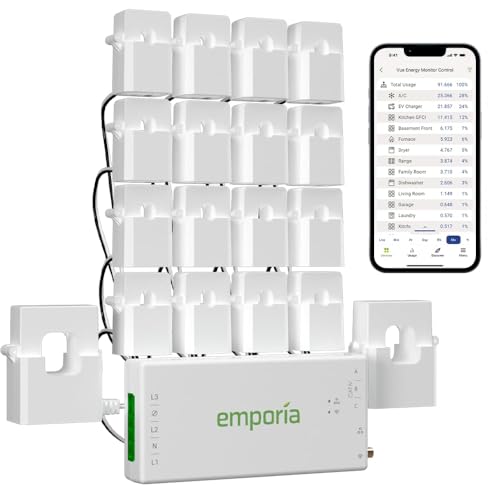
The easiest way to get the energy data a smart panel gives you, without replacing your breaker box.
Best for: Homeowners who want to see what each circuit uses before deciding whether they need a smart panel at all.
What stands out in real use
The Vue 3 goes inside your existing panel: two large sensors clamp around the main wires, and up to 16 smaller ones go on individual circuits. The app shows live readings every second, plus daily and monthly totals, and it can track solar production and net metering. That’s often enough to find out whether your home really is near its limit. However, it only monitors: it can’t switch circuits off or manage load.
Key specs
- 2 main sensors (200 A) and 16 circuit sensors (50 A)
- Single-phase, split-phase and 3-phase wye service
- 2.4 GHz Wi-Fi or Ethernet
- Per-second readings, free cloud storage
- Solar and net metering
- UL 61010 and UL 2808
Pros
- A fraction of the price of a smart panel
- Installs in your existing panel
- Detailed per-circuit data in a free app
- Tracks solar production
Cons
- Can’t switch circuits or manage load
- Needs an internet connection; data is stored in Emporia’s cloud
- Alexa and Google Assistant only control Emporia’s own plugs and chargers, not energy data
Installation and compatibility notes
Emporia says a licensed electrician or other qualified professional should install it, because the work happens inside a live panel. Home Assistant can read it through a community integration that uses Emporia’s cloud. If you also need an EV charger, Emporia’s own chargers can work with the monitor in the same app.
Price: ~$200
Leviton Whole Home Energy Monitor (LWHEM-2R) — Best for Leviton Smart Breakers

The hub that turns a Leviton Load Center into a smart panel, one breaker at a time.
Best for: Homes getting a new Leviton Load Center, or ones that already have one.
What stands out in real use
The monitor measures the whole home’s energy use and controls Leviton’s 2nd Gen Smart Circuit Breakers. In the My Leviton app you see live and historical use per circuit, get an alert when a breaker trips, and turn smart breakers on and off or put them on a schedule. Because you can mix standard and smart breakers, you only pay for smart ones on the circuits you care about, like the water heater or the EV charger. With an automatic transfer switch, it can also turn off nonessential circuits during a generator or battery outage.
Key specs
- Controls up to 60 Leviton smart breakers
- Full control requires 2nd Gen Smart Circuit Breakers
- Includes one pair of current sensors; inputs for up to three more pairs (solar, generator)
- Wi-Fi
- My Leviton app (also used for Leviton’s Decora Smart Wi-Fi devices)
Pros
- Much cheaper than a full smart panel
- Add smart breakers one circuit at a time
- Breaker trip alerts and remote on/off
- Load shedding during backup power with a transfer switch
Cons
- Only works in a Leviton Load Center
- Smart breakers cost about $90 or more each, on top of the monitor
- Leviton documents load shedding for backup power, not for avoiding a service upgrade
Installation and compatibility notes
The monitor goes on its own 2-pole breaker inside the Leviton Load Center, and Leviton says a licensed electrician should do the installation. If your current panel is another brand, you’d need a new Leviton Load Center first, so compare that quote with a smart panel.
Price: ~$292
Conclusion
A smart electrical panel replaces your breaker box with one that measures and switches every circuit, and its real value is load management: it can let you add an EV charger or heat pump without paying for a service upgrade. SPAN is the main brand, at $2,550 to $4,100 plus installation. If you only want to see your energy use, an energy monitor costs far less. If you want control over a few circuits, smart circuit breakers or a circuit sharing device usually cost less than a full smart panel. Ask your electrician for a load calculation first: it tells you whether you need any of them.
How much does a SPAN panel cost?
SPAN’s list prices run from $2,550 for the MLO 24 to $4,100 for the MAIN 40, before installation, taxes and shipping. Installing one is a full panel replacement by a SPAN authorized installer, so labor and permit costs depend on your home and where you live.
Do I need a smart panel to install an EV charger?
Not always. Ask your electrician for a load calculation first: many homes have enough capacity. If yours doesn’t, a circuit sharing device or a charger with load management can be cheaper than a smart panel, which makes the most sense when the alternative is a service upgrade.
Can I install a smart electrical panel myself?
No. A smart panel replaces your breaker box, which means working on wires that stay live even with the main breaker off, and most places require a permit and an inspection. SPAN panels can only be installed by SPAN’s authorized installers.
Does a SPAN panel work with Alexa, Google Home or HomeKit?
SPAN doesn’t list support for Alexa, Google Home, Apple Home or Matter, so you control it in the SPAN Home app. SPAN released a local API as a public beta for the MAIN 32 in 2026 and plans to add its other models, and Home Assistant users rely on community integrations.
What is a smart circuit breaker?
A smart circuit breaker protects a circuit like a standard breaker, but it also reports the circuit’s energy use and can be switched on and off from an app. Leviton’s 2nd Gen smart breakers work in Leviton Load Centers, and Eaton’s AbleEdge breakers work in Eaton BR panels.
Is a smart panel the same as a home energy monitor?
No. An energy monitor clamps sensors inside your existing panel and only measures energy use. A smart panel replaces the breaker box and can also switch circuits and pause big loads to keep your home under its service limit.

Written by Evan Mercer
Founder & Lead Researcher, Smart Home Matrix
Evan digs through spec sheets, firmware changelogs, and thousands of owner reviews so you don’t have to. Every guide starts with a compatibility check and ends with picks he would install in his own home. Read more about Evan and this site, or see exactly how we choose products.